Graphite is a good conductor of electricity due to the presence of -
Answer & explanation
Correct answer: option 2
The correct answer is Option (2) → free valence electrons
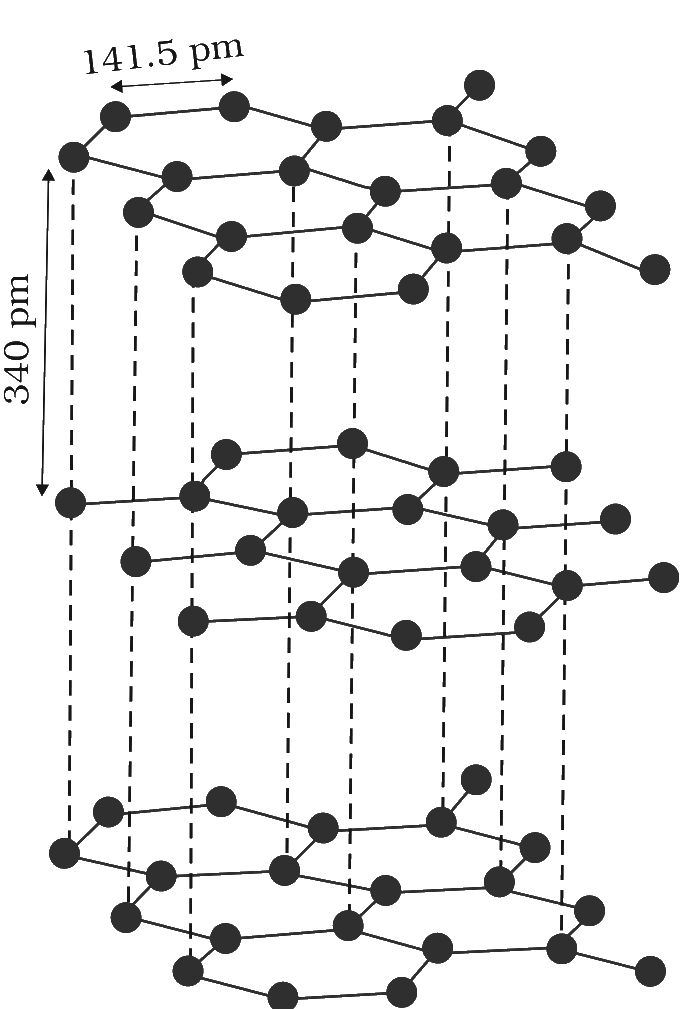
Graphite is a covalent network solid, but unlike other covalent solids it conducts electricity. Each carbon atom is sp2 hybridised and is bonded covalently to three neighbouring carbon atoms in the same layer, forming hexagonal rings. The fourth valence electron of each carbon is not used in these bonds. These electrons are delocalised over the layers and are free to move, so graphite is a good conductor of electricity.
Why the other options are incorrect
Option (1) lone pair of electrons — Incorrect. Carbon in graphite has no lone pair; all four valence electrons are used in bonding or delocalised. Lone pairs are not mobile charge carriers.
Option (3) cations — Incorrect. Graphite is not an ionic solid; it contains no ions. Moving cations carry current only in molten or dissolved ionic compounds.
Option (4) anions — Incorrect. Graphite is a covalent network of neutral carbon atoms, so it contains no anions that could carry the current.
Note: This question is from the pre-rationalised NCERT book (2022-23). The topic is not there in the latest NCERT book (2026-27), and it is also out of the CUET 2026 syllabus.
NCERT (Pre-rationalised edition, 2022-23):
Covalent or Network Solids – “… Graphite is soft and a conductor of electricity. Its exceptional properties are due to its typical structure (Fig. 1.4). Carbon atoms are arranged in different layers and each atom is covalently bonded to three of its neighbouring atoms in the same layer. The fourth valence electron of each atom is present between different layers and is free to move about. These free electrons make graphite a good conductor of electricity. Different layers can slide one over the other. This makes graphite a soft solid and a good solid lubricant.”