
Which of the following statements are correct?
(A) A solution which obeys Raoult's law strictly is called an ideal solution.
(B) A solution which shows deviations from Raoult's law is called a real solution.
(C) If $T_{b}$ is the boiling point of the solvent and T is the boiling point of the solution, then the difference in boiling points $(\Delta T_{b}=T_{b}-T)$ is called elevation of boiling point.
(D) The elevation of boiling point is related to the lowering of vapor pressure.
Choose the correct answer from the options given below:
Answer & explanation
Correct answer: option 1
The correct answer is Option (1) → (A), (B) and (D) only
Raoult's law is defined as the principle that the vapor pressure of an ideal solution is directly proportional to the vapor pressure of each component and their respective mole fractions, indicating that the presence of a solute lowers the vapor pressure compared to that of the pure solvent.
Ideal solution A solution where the interaction of component molecules does not vary from the interactions of each component's molecules. The ideal solutions are those at all concentrations and temperatures that obey Raoult's law.
Non-ideal The solutions are mixtures that do not obey Raoult’s Law because intermolecular forces between components(A-B) differ from pure components (A-A) or (B-B),
Elevation in boiling point is a colligative property where the boiling point of a solvent increases upon adding a non-volatile solute, because the solute decreases the solution's vapor pressure. The elevation, (∆Tb), is directly proportional to the solute's molality (m), expressed as (∆Tb=Kb×m) is the ebullioscopic constant.
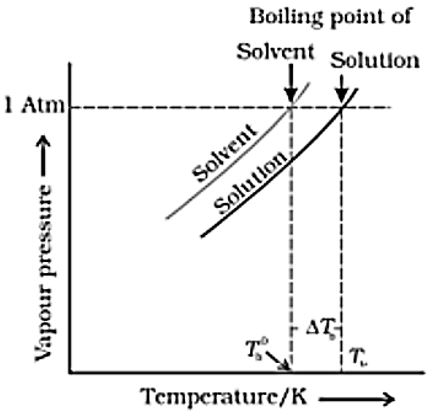
The vapour pressure curve for solution lies below the curve for pure water. The diagram shows that $ΔT_b$ denotes the elevation of boiling point of a solvent in solution,
Boiling point elevation occurs because adding a solute lowers the vapor pressure, requiring a higher temperature to boil.
Option A: A solution which obeys Raoult's law strictly is called an ideal solution Ideal solutions follow Raoult's law at all concentrations. Hence correct.
Option B: A solution which shows deviations from Raoult's law is called the Real solution Non-ideal solutions deviate from Raoult’s law. Hence correct.
Option C: ΔTb = Tb − T This is incorrect. Correct expression: ΔTᵦ = T(solution) − T(solvent) Hence wrong.
Option D: Elevation of boiling point is related to lowering of vapor pressure Addition of solute lowers vapor pressure. To boil, solution needs higher temperature. Hence boiling point increases. Correct.
So Option 1 - (A), (B) and (D) only is correct