Match List I with List II.
|
List - I |
List - II |
|
(A) Payment of loans due to partners |
(I) Realisation A/c Dr |
|
(B) For settlement of partners' accounts, in case |
(II) Bank A/c Dr |
|
(C) For settlement of loan by a firm to a partner |
(III) Bank A/c Dr |
|
(D) For settlement of any unrecorded liability |
(IV) Partner's Loan A/c Dr. |
Choose the correct answer from the options given below
Answer & explanation
Correct answer: option 1
The correct answer is Option (1) → (A)-(IV), (B)-(III), (C)-(II), (D)-(I)
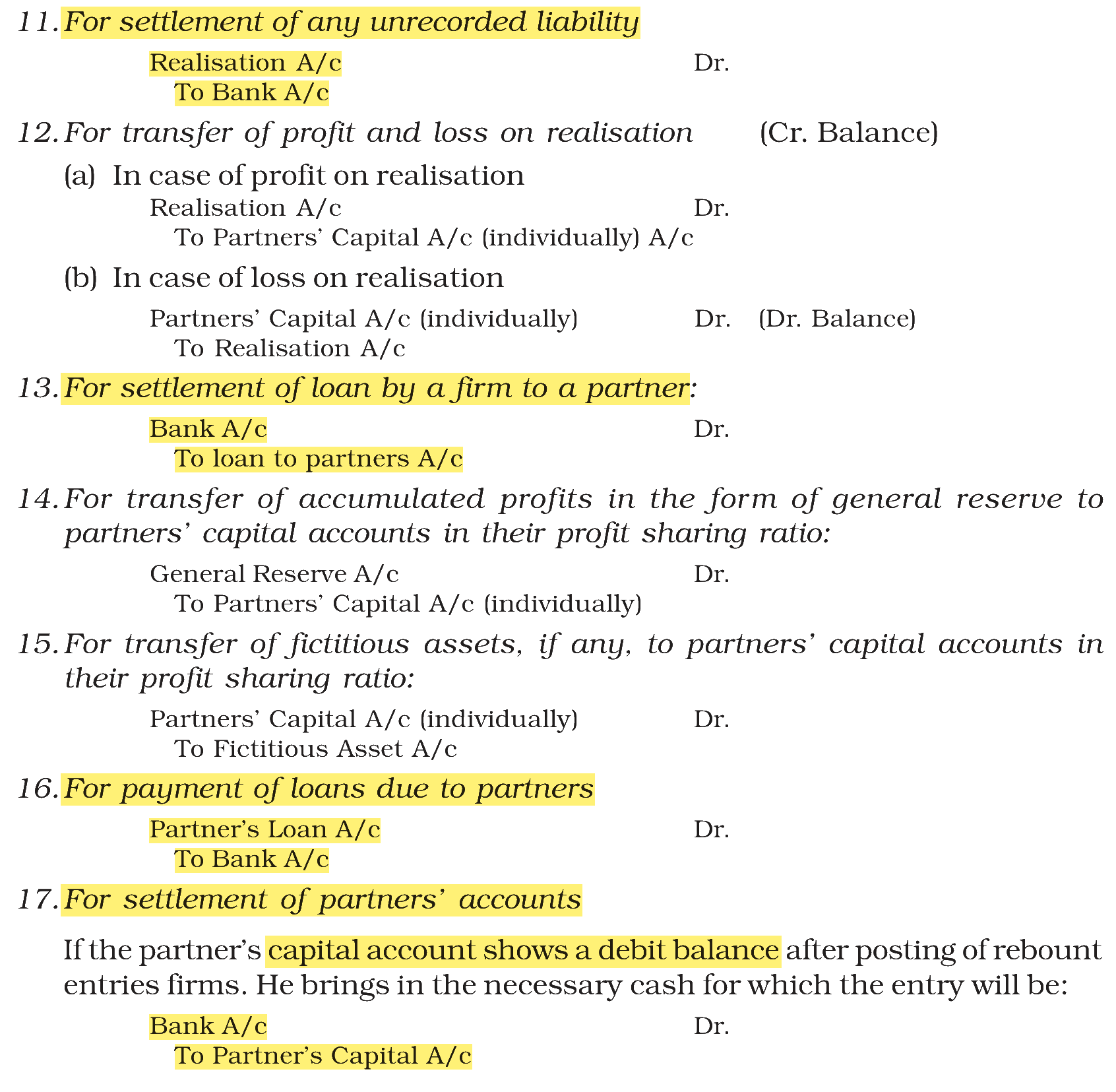
On dissolution, outside liabilities (recorded or not) are settled through the Realisation Account, while dealings with partners in their own right (their loans, loans given to them, their capital) are settled directly through their own accounts and the bank.
(A) Payment of loans due to partners — this matches (IV) Partner’s Loan A/c Dr. To Bank A/c. A partner’s loan is not transferred to the Realisation Account; it is paid off directly, closing his loan account.
(B) For settlement of partners’ accounts, in case their capital account shows a debit balance — this matches (III) Bank A/c Dr. To Partner’s Capital A/c. A partner with a debit balance brings in cash, which is credited to his capital account and closes it.
(C) For settlement of loan by a firm to a partner — this matches (II) Bank A/c Dr. To Loan to partners A/c. The partner repays the loan the firm gave him, so Bank is debited and the loan account is credited.
(D) For settlement of any unrecorded liability — this matches (I) Realisation A/c Dr. To Bank A/c. An unrecorded liability paid on dissolution is a loss on realisation, so it is debited to the Realisation Account.
NCERT (2026-27 edition):
|