
CUETMOCK
  • Pricing
  • Mentors
Log inStart freeStart free mocks→

First test, then trust

Try a free CUET mock test.

Join 5,00,000+ students who rehearsed exam day on the exact NTA screen before sitting CUET. On the web and on Android.

Start free mocks →Get the Android app
CUETMOCK

India's #1 CUET Mock Test Platform. Original NCERT-based questions on the exact NTA exam screen — trusted by 5,00,000+ students since CUET 2022.

Get it onGoogle PlayScan to download the CUETMOCK app

Mock tests

  • CUET mock test series
  • Commerce mocks
  • Humanities (Arts) mocks
  • Science mocks
  • Languages & GAT mocks
  • Free practice questions
  • Pricing

Resources

  • CUET exam guide
  • CUET syllabus
  • Universities accepting CUET
  • Expert blogs
  • News & notifications
  • Webinars & counselling
  • CUET score calculator
  • How we estimate your rank
  • FAQs

Company

  • About us
  • Our leadership & team
  • Our toppers
  • Mentors
  • For schools
  • Contact us
  • Terms
  • Privacy
  • Refund policy

Talk to us

+91 7696 6630 56info@cuetmock.comWhatsApp us

Our other platforms

  • JEE Mock — For IIT-JEE aspirants
  • NEET Mock — For NEET aspirants

Newsletter

Exam updates, study material and offers — no spam.

© 2026 NYC Ventures Pvt. Ltd.

701-702, Royal Business Park, Zirakpur, Punjab - 140603

  • Terms of use
  • Privacy policy
  • Refund policy
  • Contact us

iCUETMOCK is an independent preparation platform, not affiliated with the National Testing Agency (NTA). Always check exam details on the official NTA website.

  • Home
  • Mock tests
  • CUET guide
  • Pricing
  • Log in
Home/Practice questions/Chemistry
ChemistryOrganic: Haloalkanes and Haloarenes

Why is the C–Cl bond length in chlorobenzene less than the C–Cl bond…

Why is the C–Cl bond length in chlorobenzene less than the C–Cl bond length in chloromethane?

Answer & explanation+

Correct answer: option 2

The correct answer is Option (2) → Resonance effect in haloarenes

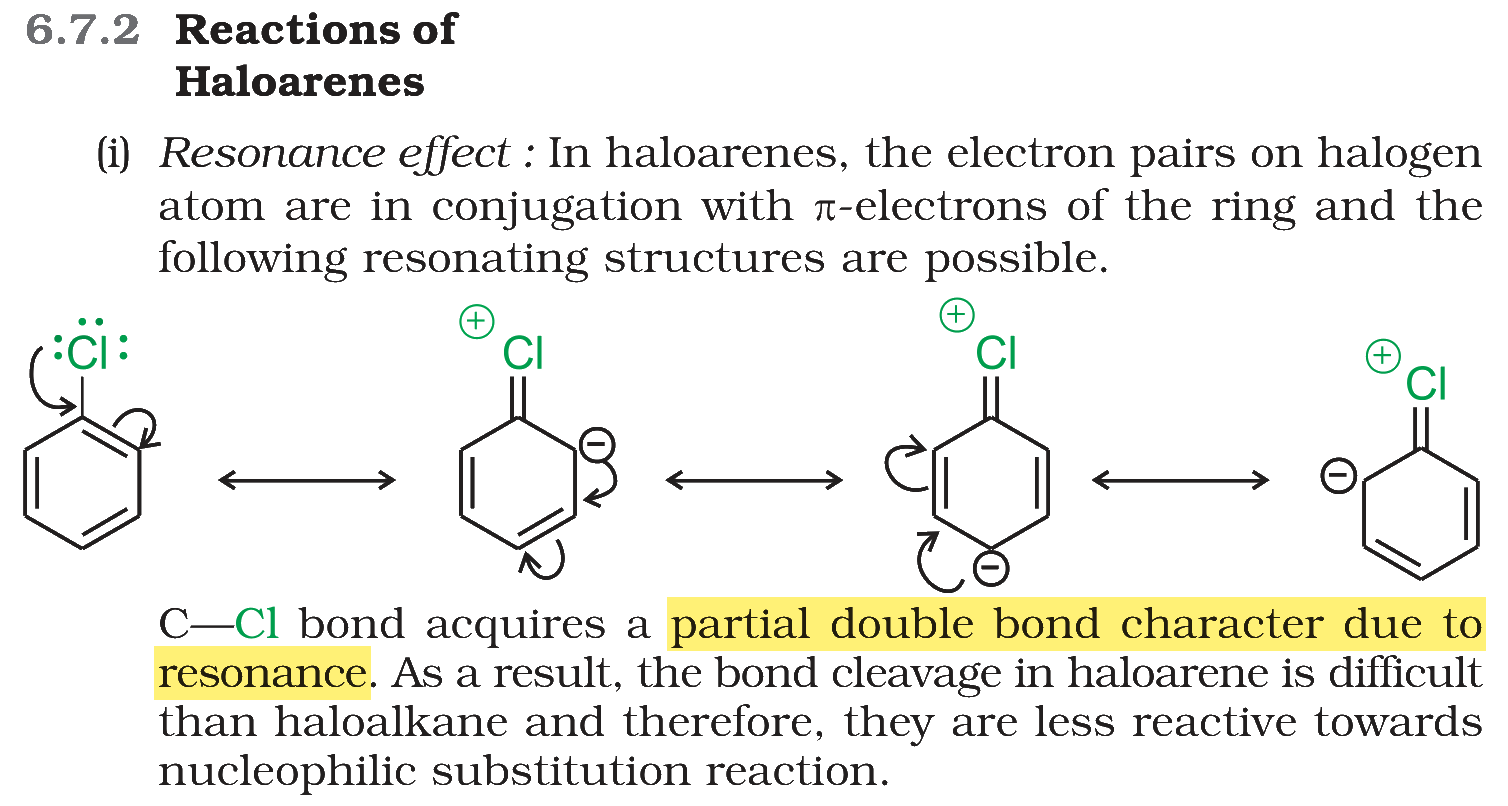
  • In chlorobenzene, resonance of a lone pair on chlorine with the ring gives the C–Cl bond partial double bond character. A bond with some double bond character is shorter and stronger than a single bond.

  • In chloromethane, \( \ce{CH3Cl} \), there is no ring and no conjugation, so the C–Cl bond is a pure single bond. Hence the C–Cl bond in chlorobenzene (169 pm) is shorter than in chloromethane (177 pm).

Why the other options are incorrect

Option (1) Possible repulsion between the nucleophile and the electron-rich ring of chlorobenzene — Incorrect. This explains why haloarenes react slowly with nucleophiles. It is about a reaction, not about the length of the bond in the molecule.

Option (3) Greater s-character of the carbon atom of the C–Cl bond in chloromethane — Incorrect.

  • It is the reverse.

  • The carbon in chloromethane is sp3 (less s-character); the carbon in chlorobenzene is sp2 (more s-character), which holds the bonding pair more tightly and also shortens the bond in chlorobenzene.

Option (4) Instability of the phenyl cation — Incorrect. The phenyl cation is not stabilised by resonance, so haloarenes do not react by the SN1 mechanism. This too is about reactivity, not bond length.

NCERT (2026-27 edition):
6.7.2 Reactions of Haloarenes
Textbook extract

Advertisement

Practise more on Organic: Haloalkanes and Haloarenes

Chapter-wise mocks on the real NTA exam screen, with solutions and your rank. Your first mocks are free.

Start free mocks →

Advertisement

Next questions

  1. Two identical containers A and B have frictionless pistons. They contain the same volume of an ideal gas at the same temperature. The mass…Physics · Kinetic Theory
  2. Which programme of the Government of India is a series of initiatives aimed at port-led development along the country’s coastline and its h…General Aptitude Test · General Knowledge
  3. Four positions of a dice are shown. What number must be at the bottom face when the dice is in the position as shown in figure (a)?General Aptitude Test · Verbal Reasoning
  4. Central Vigilance Commission (CVC) was set up on the recommendation of which Committee?Legal Studies · Arbitration, Tribunal Adjudication and Alternate Dispute resolution
  5. पद्यांश में योग का संदेश किन्हें सौंपने की बात कही गई है?Hindi · अपठित काव्यांश (Comprehension - Poetry)
  6. The function f(x) = x^2-x+1 isMaths. Section B1 · Applications of Derivatives
  7. ‘A + B’ means ‘A is the husband of B’. ‘A % B’ means ‘A is the father of B’. ‘A $ B’ means ‘A is the mother of B’. If ‘$Y + Z ~$~ H % C~$~…General Aptitude Test · Verbal Reasoning
  8. Match List I with List II List I Given pair of organic compounds can be distinguished by List II Tests 1. Ethanal/ Propanal I. Sodium Hydro…Chemistry · Organic: Aldehydes, Ketones and Carboxylic Acids
  9. Three of the following four are alike in a certain way and so form a group. Which is the one that does not belong to that group?General Aptitude Test · General Ability
  10. Rearrange the events of life cycle of a retrovirus.A. New viral RNA produced by infected cellB. Reverse transcriptionC. New virus particles…Biology · Human Health and Disease