
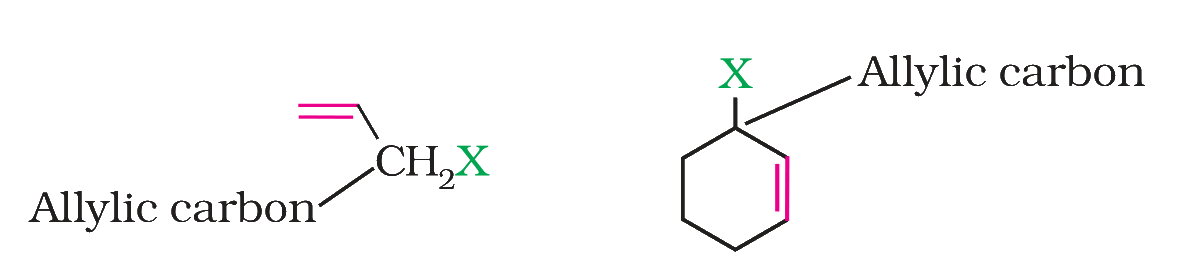
The figure shows two allylic halides (X = a halogen atom), with the allylic carbon marked in each.
Which of the following correctly describes the marked allylic carbon?
Answer & explanation
Correct answer: option 2
The correct answer is Option (2) → It is sp3 hybridised and is next to the C=C bond.
In both structures the marked carbon carries X and is joined to its neighbours only by single bonds, so it is sp3 hybridised.
In the open-chain halide, X is on the CH2 group, which is bonded to a carbon of the coloured double bond. In the ring halide, X is on the ring carbon beside the coloured double bond, not on a carbon of that bond.
In each case the marked carbon is next to the C=C bond.
Why the other options are incorrect
Option (1) It is sp2 hybridised and is one of the two carbon atoms of the C=C bond. — Incorrect. This describes a vinylic carbon; a halogen on it would make a vinylic halide.
Option (3) It is sp3 hybridised and is attached to an aromatic ring. — Incorrect. This describes a benzylic carbon; neither structure has an aromatic ring.
Option (4) It is sp2 hybridised and is next to the C=C bond. — Incorrect. The marked carbon has no double bond of its own, so it cannot be sp2.
NCERT (2026-27 edition):
6.1.2 Compounds Containing sp3 C—X Bond – “(b) Allylic halides: These are the compounds in which the halogen atom is bonded to an sp3-hybridised carbon atom adjacent to carbon-carbon double bond (C=C) i.e. to an allylic carbon.”
6.1.3 Compounds Containing sp2 C—X Bond – “(a) Vinylic halides: These are the compounds in which the halogen atom is bonded to a sp2-hybridised carbon atom of a carbon-carbon double bond (C = C).”
Allylic halides (6.1.2)