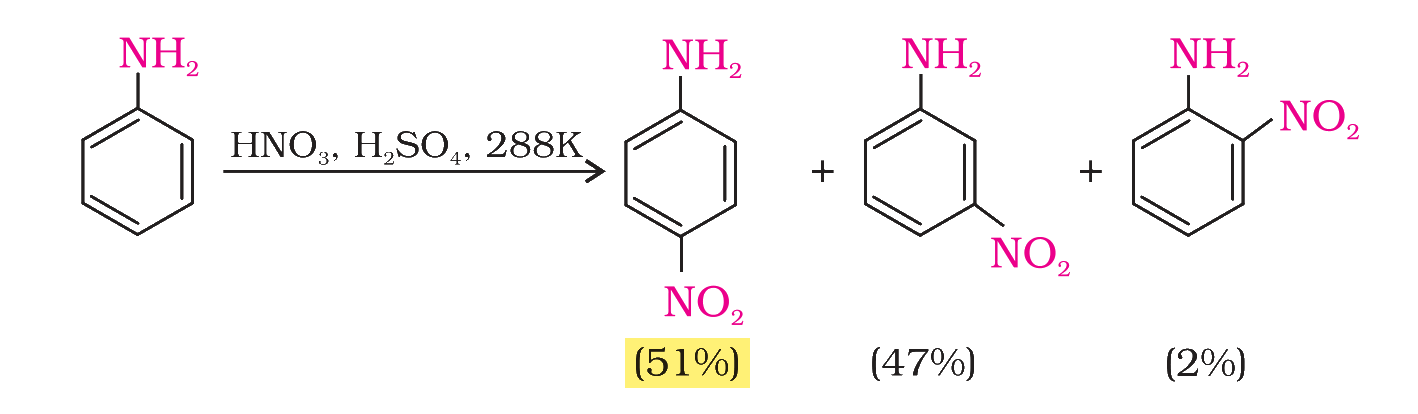
The amino group is ortho, para directing and a powerful activating group, so aryl amines undergo the typical electrophilic substitution reactions readily. In fact, the rate of these reactions is so great that in certain cases poly-substitution, rather than mono-substitution, occurs even under mild conditions. If the reaction has to be stopped at the mono-substitution stage, the activating effect of the –NH2 group has to be controlled.
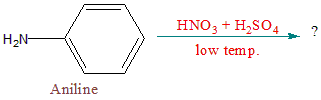
Identify the major product of the given reaction.
Answer & explanation
Correct answer: option 3
The correct answer is Option (3) → p-Nitroaniline
The –NH2 group is ortho, para directing. But in the strongly acidic nitrating mixture much of the aniline is protonated to the anilinium ion, \( \ce{C6H5NH3^+} \), which is meta directing. So direct nitration gives all three mononitro products:
\( \displaystyle \ce{C6H5NH2 + HNO3} \xrightarrow[288\,\mathrm{K}]{\ce{H2SO4}} \ce{O2N-C6H4-NH2 + H2O} \)
para: 51%
meta: 47%
ortho: 2%
The largest share is the para isomer, so the major product is p-nitroaniline. Tarry oxidation products are also formed.
Why the other options are incorrect
Option (1) m-Nitroaniline — Incorrect. A large amount forms through the anilinium ion (47%), but it is less than the para product (51%).
Option (2) o-Nitroaniline — Incorrect. Only about 2% of the product is the ortho isomer.
Option (4) 2,4-Dinitroaniline — Incorrect. The products of this nitration are the three mononitro anilines.
NCERT (2026-27 edition):
9.6 Chemical Reactions – “(b) Nitration: Direct nitration of aniline yields tarry oxidation products in addition to the nitro derivatives. Moreover, in the strongly acidic medium, aniline is protonated to form the anilinium ion which is meta directing. That is why besides the ortho and para derivatives, significant amount of meta derivative is also formed.”