
Carbylamine reaction is used as a test for -
Answer & explanation
Correct answer: option 2
The correct answer is Option (2) → Primary Amines
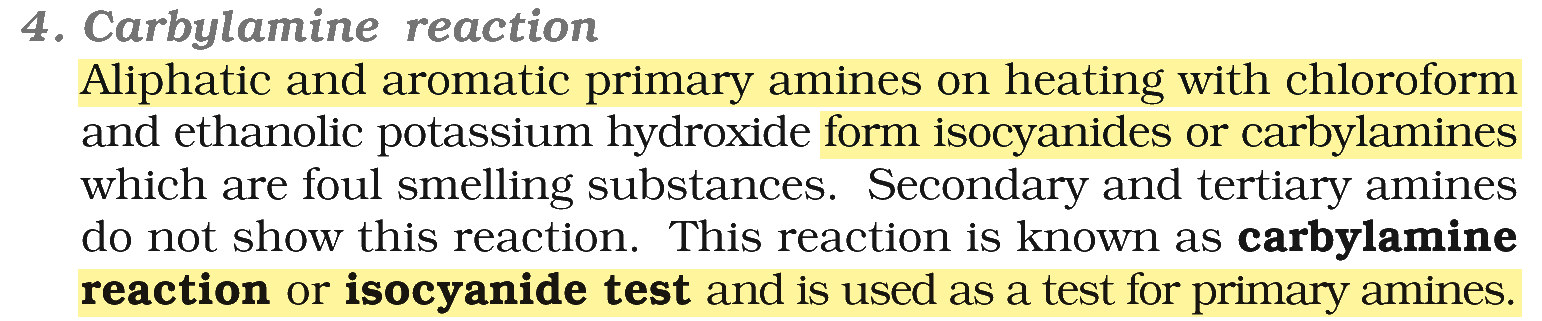
In the carbylamine reaction, for example with an alkyl amine or with aniline:
\( \displaystyle \ce{R-NH2 + CHCl3 + 3KOH} \xrightarrow{\text{heat}} \ce{R-NC + 3KCl + 3H2O} \)
\( \displaystyle \ce{C6H5-NH2 + CHCl3 + 3KOH} \xrightarrow{\text{heat}} \ce{C6H5-NC + 3KCl + 3H2O} \)
To form the R–N≡C group, the nitrogen must lose both of its hydrogen atoms. Only a primary amine has two H atoms on nitrogen, so only it gives the reaction.
Why the other options are incorrect
Option (1) Tertiary Amines — Incorrect. \( \ce{R3N} \) has no H on nitrogen, so no isocyanide can form.
Option (3) Quaternary Amines — Incorrect. Quaternary ammonium salts (\( \ce{R4N^{+}X^{-}} \)) have no N–H and no lone pair on nitrogen.
Option (4) Secondary Amines — Incorrect. \( \ce{R2NH} \) has only one H on nitrogen, not the two that are needed.
NCERT (2026-27 edition):
Carbylamine Reaction
Note: The same/similar question has been asked in different years by NTA as per the details given below:
| 2026 | 2025 | 2024 | 2023 | 2022 |
|---|---|---|---|---|
| 07-06 S2 | 26-05 S2 23-05 S2 | – | – | – |