Which of the following ions does not impart any colour in aqueous solution?
Answer & explanation
Correct answer: option 2
The correct answer is Option (2) → Sc3+
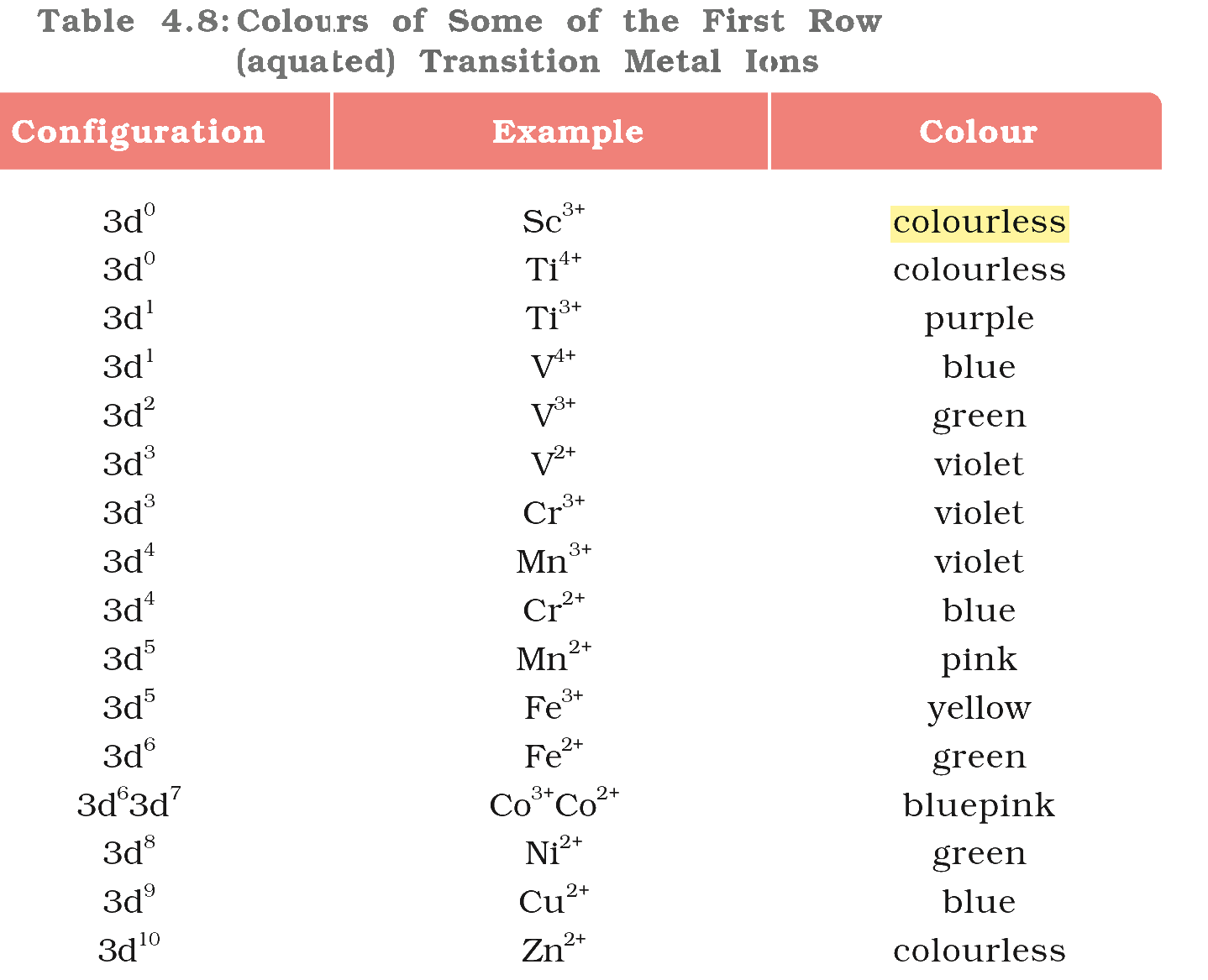
Most transition metal ions are coloured in aqueous solution. The water ligands split the d orbitals into two sets of slightly different energy. An electron in the lower set absorbs visible light and jumps to the higher set (a d–d transition), and we see the complementary colour. This needs a partly filled d subshell:
d0 ions have no d electron to promote, so they are colourless.
d10 ions have no vacant d orbital to receive an electron, so they are also colourless.
Scandium (Z = 21) is [Ar]3d14s2; losing the two 4s electrons and the one 3d electron gives Sc3+: 3d0. No d–d transition is possible, so Sc3+ is colourless.
Option (1) Mn2+ — Imparts a colour. Mn (Z = 25) is [Ar]3d54s2; losing the two 4s electrons gives 3d5, with d–d transitions possible; its aqueous solution is very pale pink.
Option (2) Sc3+ — Does not impart any colour. It is 3d0 (worked out above), so no d–d transition is possible.
Option (3) Fe3+ — Imparts a colour. Fe (Z = 26) is [Ar]3d64s2; losing the two 4s electrons and one 3d electron gives 3d5; its aqueous solution is yellow.
Option (4) Co2+ — Imparts a colour. Co (Z = 27) is [Ar]3d74s2; losing the two 4s electrons gives 3d7; its aqueous solution is pink.
NCERT (2026-27 edition):
Formation of Coloured Ions – …