Match List-I with List-II
| List-I | List-II |
| (A) Increase in demand and no change in supply | (I) Equilibrium quantity decreases. |
| (B) Both demand and supply increase | (II) Equilibrium quantity increases. |
| (C) Decrease in supply and no change in demand | (III) Change in price depends on magnitude of shift |
| (D) Increase in demand and decrease in supply | (IV) Equilibrium price increases. |
Choose the correct answer from the options given below:
Answer & explanation
Correct answer: option 1
The correct answer is Option (1) → (A) - (II), (B) - (III), (C) - (I), (D) - (IV)
The price and the quantity of a good settle where the demand curve meets the supply curve; this point is the market equilibrium. An increase in demand or supply shifts that curve to the right (more is demanded, or offered, at every price); a decrease shifts it to the left. If, at the old price, buyers now want more than sellers offer, there is excess demand and the price rises; if sellers offer more than buyers want, there is excess supply and the price falls.
Take the cases one at a time:
Only one curve shifts: the equilibrium moves along the other, unchanged curve, so the direction of both price and quantity is certain.
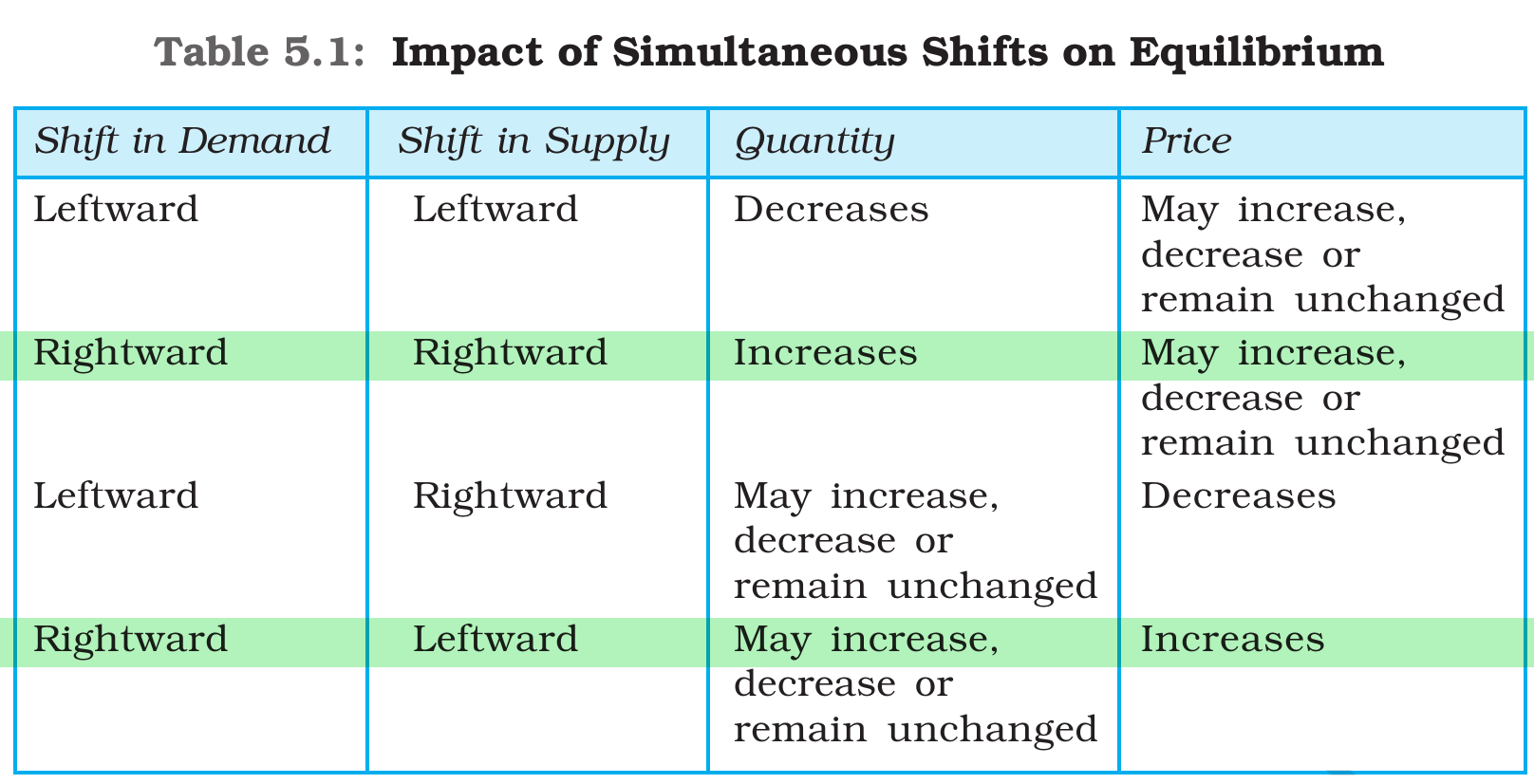
Both curves shift: the two shifts push one of the two variables the same way, so it moves for certain; they pull the other in opposite directions, so its change depends on which shift is larger.
(A) Increase in demand and no change in supply — this matches (II) Equilibrium quantity increases. The demand curve shifts to the right along the unchanged supply curve; excess demand at the old price raises the price, and the quantity bought and sold rises with it.
(B) Both demand and supply increase — this matches (III) Change in price depends on magnitude of shift. Both shifts raise the quantity. The rise in demand pushes the price up while the rise in supply pulls it down, so the price may rise, fall or stay the same.
(C) Decrease in supply and no change in demand — this matches (I) Equilibrium quantity decreases. The supply curve shifts to the left along the unchanged demand curve; excess demand at the old price raises the price, and the quantity falls.
(D) Increase in demand and decrease in supply — this matches (IV) Equilibrium price increases. Both shifts create excess demand at the old price, so the price rises for certain. The quantity rises or falls depending on whether the demand shift or the supply shift is larger.
Note: Some items of List-I can be matched with more than one entry of List-II:
(A) Increase in demand and no change in supply → both (II) and (IV). The demand curve shifts to the right along the unchanged supply curve, so the equilibrium quantity and the equilibrium price both rise.
(B) Both demand and supply increase → both (II) and (III). Both shifts raise the equilibrium quantity, while the price may rise, fall or stay the same depending on the size of the two shifts.
(C) Decrease in supply and no change in demand → both (I) and (IV). The supply curve shifts to the left along the unchanged demand curve, so the equilibrium quantity falls and the equilibrium price rises.
NCERT (2025-26): “Simultaneous Shifts of Demand and Supply … What happens when both demand and supply curves shift simultaneously? The simultaneous shifts can happen in four possible ways: (i) Both supply and demand curves shift rightwards. (ii) Both supply and demand curves shift leftwards. (iii) Supply curve shifts leftward and demand curve shifts rightward. (iv) Supply curve shifts rightward and demand curve shifts leftward. The impact on equilibrium price and quantity in all the four cases are given in Table 5.1. Each row of the table describes the direction in which the equilibrium price and quantity will change for each possible combination of the simultaneous shifts in demand and supply curves. For instance, from the second row of the table, we see that due to a rightward shift in both demand and supply curves, the equilibrium quantity increases invariably but the equilibrium price may either increase, decrease or remain unchanged. The actual direction in which the price will change will depend on the magnitude of the shifts. Check this yourself by varying the magnitude of shifts for this particular case. In the first two cases which are shown in the first two rows of the table, the impact on equilibrium quantity is unambiguous but the equilibrium price may change, if at all, in either direction depending on the magnitudes of shifts. In the next two cases, shown in the last two rows of the table, the effect on price is unambiguous whereas effect on quantity depends on the magnitude of shifts in the two curves.”
|