
CUETMOCK
  • Pricing
  • Mentors
Log inStart freeStart free mocks→

First test, then trust

Try a free CUET mock test.

Join 5,00,000+ students who rehearsed exam day on the exact NTA screen before sitting CUET. On the web and on Android.

Start free mocks →Get the Android app
CUETMOCK

India's #1 CUET Mock Test Platform. Original NCERT-based questions on the exact NTA exam screen — trusted by 5,00,000+ students since CUET 2022.

Get it onGoogle PlayScan to download the CUETMOCK app

Mock tests

  • CUET mock test series
  • Browse all papers
  • Commerce mocks
  • Humanities (Arts) mocks
  • Science mocks
  • Languages & GAT mocks
  • Free practice questions
  • Pricing

Resources

  • CUET exam guide
  • CUET syllabus
  • Universities accepting CUET
  • Expert blogs
  • News & notifications
  • Webinars & counselling
  • CUET score calculator
  • How we estimate your rank
  • FAQs

Company

  • About us
  • Our leadership & team
  • Our toppers
  • Mentors
  • For schools
  • Contact us
  • Terms
  • Privacy
  • Refund policy

Talk to us

+91 7696 6630 56info@cuetmock.comWhatsApp us

Our other platforms

  • JEE Mock — For IIT-JEE aspirants
  • NEET Mock — For NEET aspirants

Newsletter

Exam updates, study material and offers — no spam.

© 2026 NYC Ventures Pvt. Ltd.

701-702, Royal Business Park, Zirakpur, Punjab - 140603

  • Terms of use
  • Privacy policy
  • Refund policy
  • Contact us

iCUETMOCK is an independent preparation platform, not affiliated with the National Testing Agency (NTA). Always check exam details on the official NTA website.

  • Home
  • Mock tests
  • CUET guide
  • Pricing
  • Log in
Home/Practice questions/Physics
PhysicsElectrostatic Potential and Capacitance

A point charge q moves from point P to S along the path PQRS in a uni…

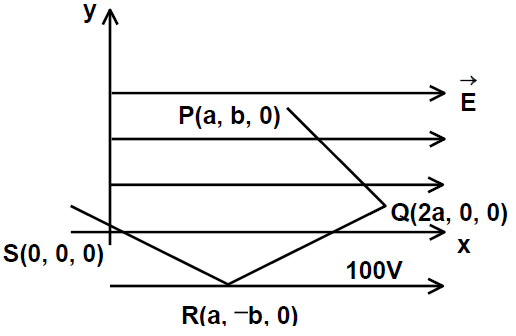
A point charge q moves from point P to S along the path PQRS in a uniform electric field $\vec{E}$ pointing parallel to the positive direction of the x-axis. The coordinate of the point P, Q, R and S are (a, b, 0), (2a, 0, 0), (a, −b, 0) and (0, 0, 0) respectively. The work done by the field in the above process is given by the expression
Answer & explanation+

Correct answer: option 2

The work done is independent of the path followed and is equal to $(q \vec{E}) . \vec{r}$

where $\vec{r}=$ displacement from P to S

Here, $\vec{r}=a \hat{i}-b \hat{j}$, while $\vec{E}=E \hat{i}$

∴ work = $-(q E \hat{i}) . (a \hat{i}+b \hat{j})=-q a E$

Hence, B is correct choice.

Advertisement

Practise more on Electrostatic Potential and Capacitance

Chapter-wise mocks on the real NTA exam screen, with solutions and your rank. Your first mocks are free.

Start free mocks →

Advertisement

Next questions

  1. If (x+1)e^y=1 , then :Maths. Section A · Continuity and Differentiability (Section A)
  2. Consider the following statements and choose the correct option. Statement 1: The idea of gender-just society is based upon two important f…Sociology · Social Change and Development in India: Social Movements
  3. Two lenses of focal lengths 20 cm and – 40 cm are held in contact. Where will the image of an object at infinity be formed by the combinati…Physics · Ray Optics
  4. The words -procedure established by law- means:Legal Studies · Human Rights in India
  5. Which of the following is the correct process of setting up an enterprise?Business Studies · Entrepreneurship Development
  6. Network of roads, railways and waterways has been often described as __________.Geography · Fundamentals of Human Geography: Human Geography-Nature and Scope
  7. The wavelength of light emitted from second orbit to first orbits in a hydrogen atom isPhysics · Atoms
  8. Which of the following is NOT true about manufacturing activity?Geography · Fundamentals of Human Geography: Secondary Activities
  9. At what time are the hands of clock at 48o angle between 4 and 5 o’clock?General Aptitude Test · Verbal Reasoning
  10. Match the following leaders in List 1 with the work done by them in List 2: List 1 (Leaders) List 2 (Work) (i) K. Kamraj (a) Abolition of P…Political Science · Politics in India Since Independence: Challenges to and Restoration of the Congress System