Which of the following statements is correct?
Answer & explanation
Correct answer: option 1
The correct answer is Option (1) → for weak field ligand \(\Delta_o \lt P\)
In an octahedral complex the ligands split the five d orbitals into a lower \( t_{2g} \) set and a higher \( e_g \) set, separated by the crystal field splitting energy \( \Delta_o \). For a \( d^4 \) ion, the fourth electron can either pair up in a \( t_{2g} \) orbital, which costs the pairing energy P, or go into an \( e_g \) orbital, which costs \( \Delta_o \). It takes the cheaper path:
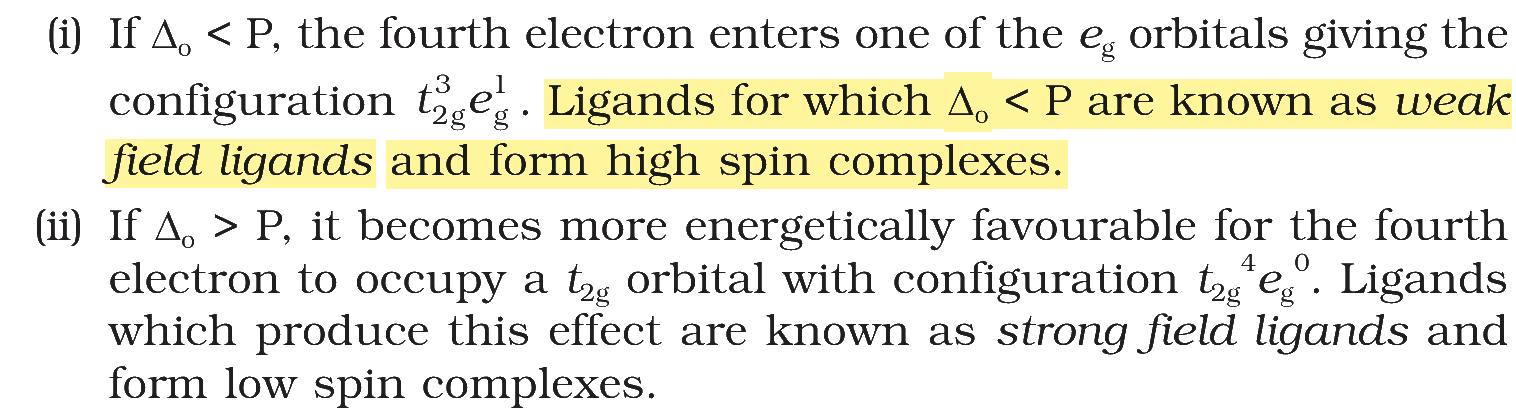
If \( \Delta_o \lt P \), the electron enters \( e_g \): configuration \( t_{2g}^{3}\,e_g^{1} \). Such ligands are weak field ligands and give high spin complexes.
If \( \Delta_o \gt P \), the electron pairs in \( t_{2g} \): configuration \( t_{2g}^{4}\,e_g^{0} \). Such ligands are strong field ligands and give low spin complexes.
So for a weak field ligand \( \Delta_o \lt P \), and Option (1) is the correct statement. The ligands are ranked by the size of the splitting they cause, the spectrochemical series:
\( \displaystyle \ce{I-} \lt \ce{Br-} \lt \ce{SCN-} \lt \ce{Cl-} \lt \ce{S^2-} \lt \ce{F-} \lt \ce{OH-} \lt \ce{C2O4^2-} \lt \ce{H2O} \lt \ce{NCS-} \lt \text{edta}^{4-} \lt \ce{NH3} \lt \text{en} \lt \ce{CN-} \lt \ce{CO} \)
Why the other options are incorrect
Option (2) \(CN^-\) is a weak field ligand — Incorrect. Cyanide is near the strong end of the series and causes a large splitting; it is a strong field ligand.
Option (3) weak field ligand yield low spin complex — Incorrect. With a weak field ligand \( \Delta_o \lt P \), so the electrons stay unpaired as far as possible and the complex is high spin.
Option (4) \(I^-\) is a strong field ligand — Incorrect. Iodide is at the very start of the series; it is the weakest field ligand listed.
NCERT (2026-27 edition):
Crystal Field Theory – …