
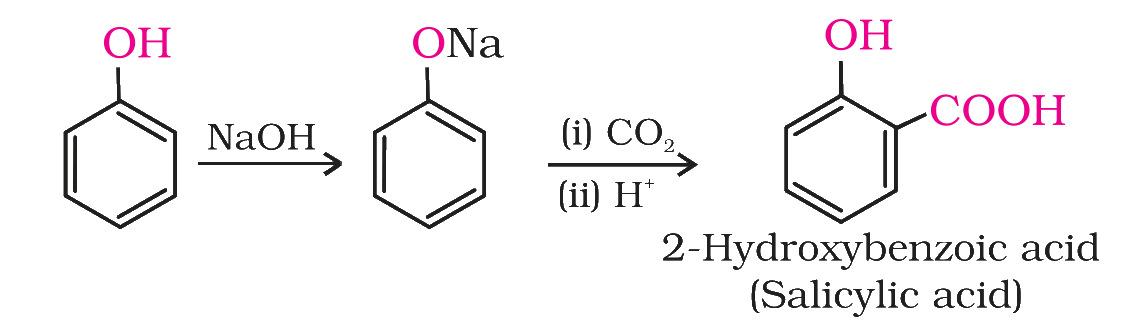
The scheme shows the preparation of 2-hydroxybenzoic acid (salicylic acid) from phenol.
What is the purpose of the first step, in which phenol is treated with sodium hydroxide?
Answer & explanation
Correct answer: option 2
The correct answer is Option (2) → It forms sodium phenoxide, whose phenoxide ion is more reactive than phenol towards the weak electrophile CO2.
The scheme is Kolbe’s reaction. In the first step sodium hydroxide turns phenol into sodium phenoxide (the –ONa compound in the scheme).
\( \displaystyle \ce{C6H5OH + NaOH -> C6H5ONa + H2O} \)
The phenoxide ion is even more reactive than phenol towards electrophilic substitution, so it is attacked by carbon dioxide, a weak electrophile.
Acidification (H+) then gives 2-hydroxybenzoic acid, with the –COOH group ortho to the –OH group.
Why the other options are incorrect
Option (1) Sodium hydroxide acts as a catalyst and is recovered unchanged at the end of the reaction. — Incorrect. Sodium hydroxide is used up: it reacts with phenol and forms sodium phenoxide, the compound attacked in the next step.
Option (3) It forms sodium phenoxide, whose phenoxide ion is less reactive than phenol, so that a single group enters the ring. — Incorrect. The phenoxide ion is more reactive than phenol, not less; this is why the weak electrophile CO2 can react with it.
Option (4) Sodium hydroxide supplies the –OH group that becomes part of the –COOH group of the product. — Incorrect. The –COOH group comes from CO2 and the H+ of the acidification step; NaOH only forms the phenoxide.
NCERT (2026-27 edition):
7.4.4 Chemical Reactions – “2. Kolbe’s reaction
Phenoxide ion generated by treating phenol with sodium hydroxide is even more reactive than phenol towards electrophilic aromatic substitution. Hence, it undergoes electrophilic substitution with carbon dioxide, a weak electrophile. Ortho hydroxybenzoic acid is formed as the main reaction product.”
Kolbe’s reaction (7.4.4)