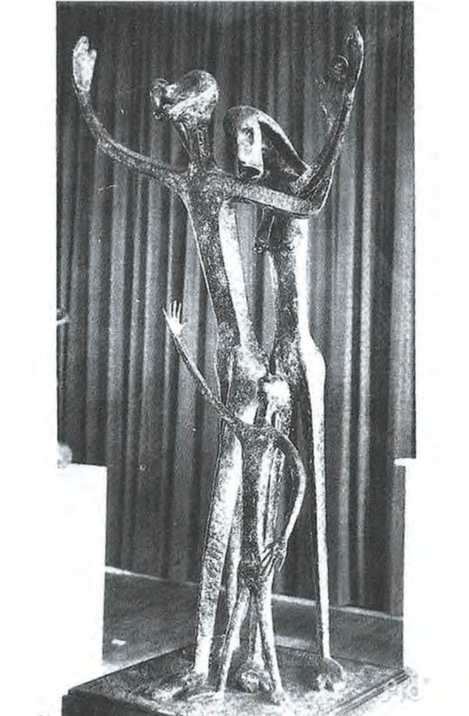
Observe the image and answer the following question.
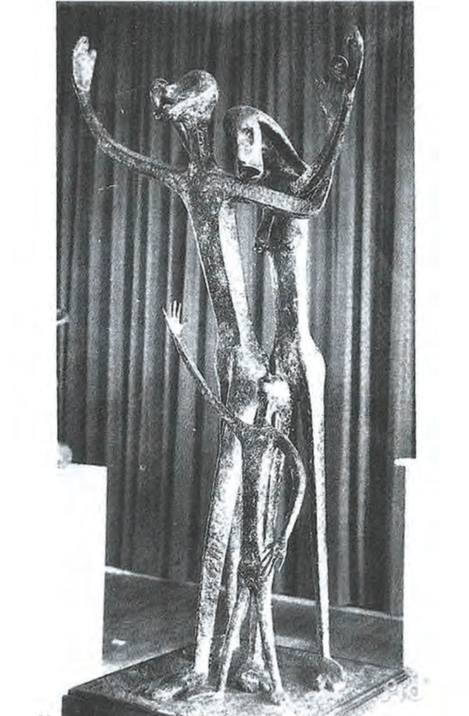
Observe the bronze sculpture in the image. How many figures are shown in it, and how are they rendered?
Answer & explanation
Correct answer: option 3
The correct answer is Option (3) → Three, stick-like in flat rhythmical planes
Option (1) Three, as concave planes with welded linear details — Incorrect. Concave planes with welded linear details belong to P. V. Janakiram’s copper Ganesha. This bronze uses flat abstract planes.
Option (2) Four, with strong musculature and veins shown — Incorrect. Strong musculature with bones and veins marks D. P. Roy Chowdhury’s Triumph of Labour, with four men. This work is abstract, not muscular.
Option (3) Three, stick-like in flat rhythmical planes — Correct. In Cries Un-heard by Amarnath Sahgal, three figures are stick-like in flat rhythmical planes.
Option (4) Four, stick-like in flat rhythmical planes — Incorrect. The rendering is right, but there are three figures, not four: a husband, wife and child.
NCERT (2026-27): “Cries Un-heard This is a sculpture in bronze made by Amarnath Sahgal in 1958. Although the artist only uses abstraction, in which three figures are stick-like and shown in flat rhythmical planes, yet it is easy to understand them as a family — husband, wife and child. They are shown flinging their arms above and crying out for help in vain. Through the medium of sculpture, their helplessness expressed by the hand gesture is turned into a permanent shape.…”
|