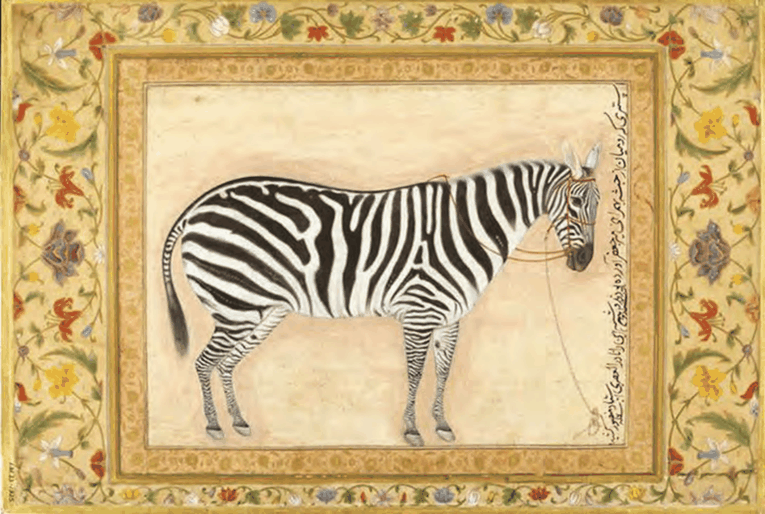
Observe the image and read the passage given below and answer the question that follows:
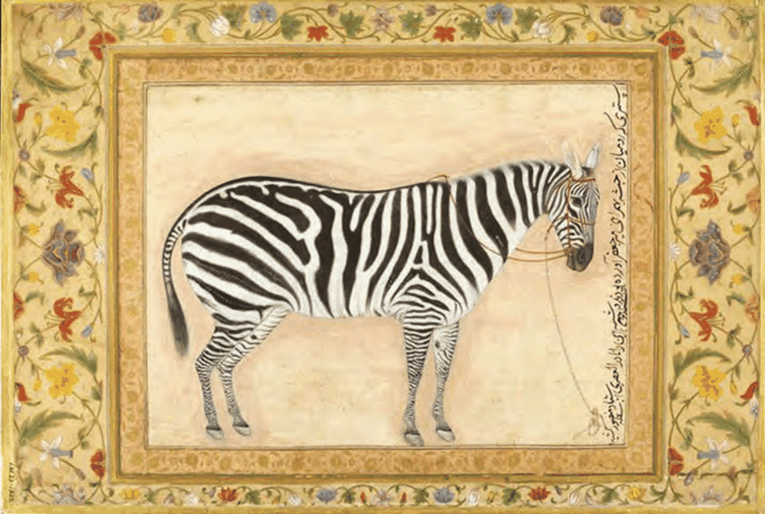
The zebra in the painting was from Ethiopia, brought by Turks, and presented to Mughal emperor Jahangir by his nobleman Mir Ja’far, who had acquired it. Jahangir wrote on the painting in Persian, the court language, that it was: “A mule which the Turks (rumiyan) in the company of Mir Ja’far had brought from Ethiopia [Habesha]”.
What was Ustad Mansur’s connection with the zebra shown in the painting?
Answer & explanation
Correct answer: option 2
The correct answer is Option (2) → He drew the likeness of the zebra in the painting.
Option (1) He recorded its arrival at Nowruz in the Jahangirnama. — Incorrect. The Jahangirnama is Jahangir’s official biography. It states that the zebra was presented to him at Nowruz.
Option (2) He drew the likeness of the zebra in the painting. — Correct. The zebra’s likeness was drawn by Ustad Mansur, called Nadir ul asr (Wonder of the Age).
Option (3) He examined it, as some thought it was a horse with painted stripes. — Incorrect. It was Jahangir who examined the animal carefully.
Option (4) He received the painting and added it to the royal album. — Incorrect. The painting later came into Shah Jahan’s possession and was added to the royal album.
Note: This topic was not named in the CUET 2026 syllabus, but it was part of the NCERT chapter. In 2025 and 2026, NTA also asked questions on topics in NCERT that the CUET syllabus did not name. So our mocks have questions from every part of the NCERT chapter, to give you enough practice. Read the whole chapter, not only the sub-topics named in the syllabus.
NCERT (2026-27): “Zebra The zebra in this painting was from Ethiopia, brought by Turks, and presented to Mughal emperor Jahangir by his nobleman Mir Ja’far, who had acquired it. Jahangir wrote on the painting in Persian, the court language, that it was: “A mule which the Turks (rumiyan) in the company of Mir Ja’far had brought from Ethiopia [Habesha]”. Its likeness was drawn by Nadir ul asr (Wonder of the Age) Ustad Mansur. In Jahangirnama, it is clearly stated that the animal was presented to him during Nowruz or New Year festivities in March 1621. It is also mentioned that Jahangir had carefully examined it as some thought that it was a horse on which someone had painted stripes. … The painting later came in Emperor Shah Jahan’s possession. It was added to the royal album of paintings and calligraphies.”
|