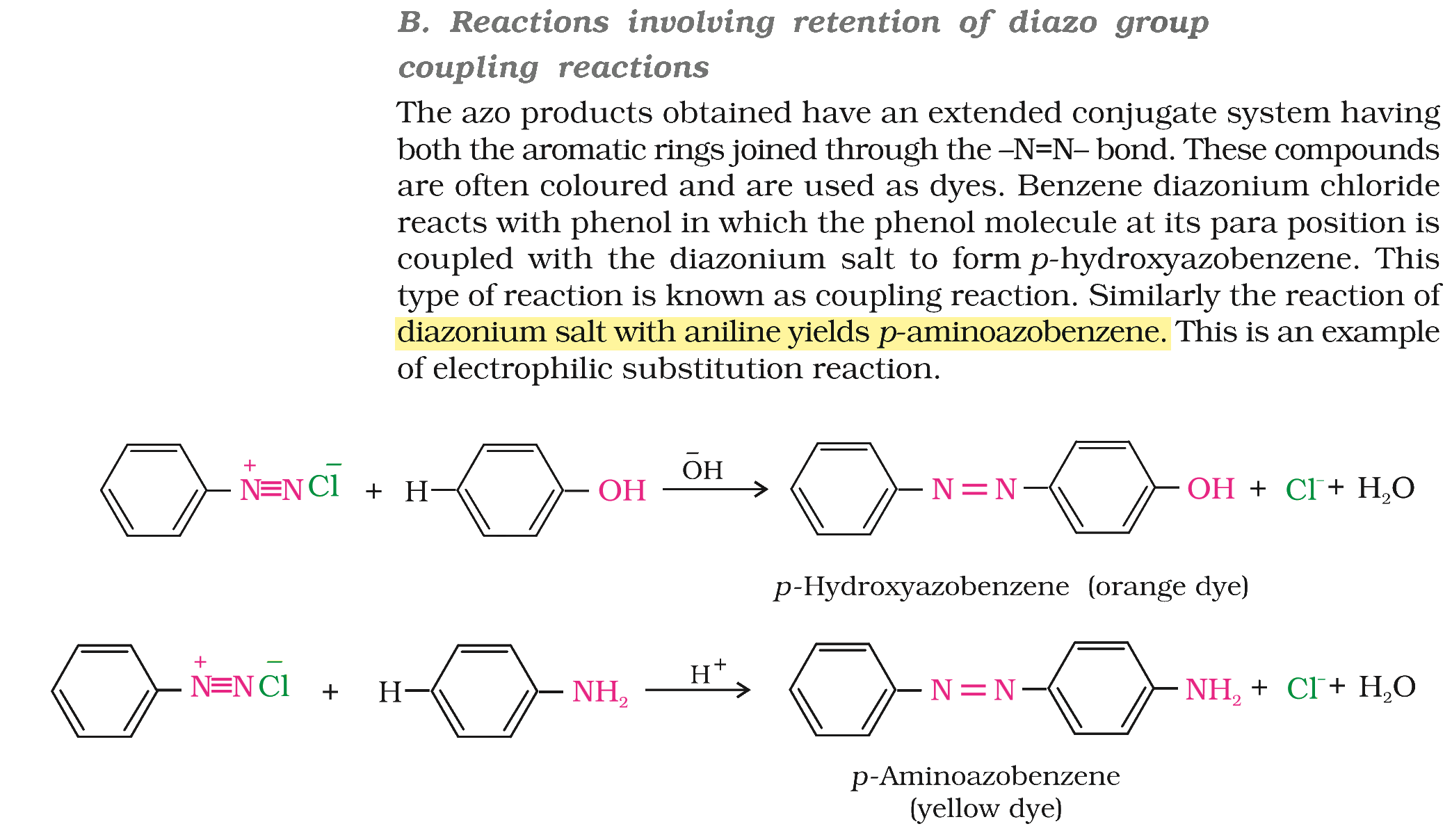
p-Aminoazobenzene, a yellow dye, is produced in
Answer & explanation
Correct answer: option 3
The correct answer is Option (3) → Coupling reaction
Benzenediazonium chloride reacts with phenol or aniline, the diazonium ion attacking the para position of the ring, to give brightly coloured azo compounds in which the two rings are joined through the –N=N– group. This is called a coupling reaction; it is an electrophilic substitution in which the diazo group is retained. The reaction with aniline gives p-aminoazobenzene, a yellow dye:
\( \displaystyle \ce{C6H5N2+Cl- + C6H5NH2} \xrightarrow{\ce{H+}} p\text{-}\ce{C6H5-N=N-C6H4NH2 + HCl} \)
With phenol in alkaline medium the product is p-hydroxyazobenzene, an orange dye.
Why the other options are incorrect
Option (1) Diazotization — Incorrect. Diazotisation is the conversion of aniline into benzenediazonium chloride with \( \ce{NaNO2} \) + HCl at 273–278 K. It prepares the diazonium salt but does not form the azo dye.
Option (2) Ammonolysis — Incorrect. The reaction of an alkyl halide with ammonia, which gives a mixture of amines and a quaternary ammonium salt; no –N=N– group is formed.
Option (4) Gabriel phthalimide synthesis — Incorrect. A method for preparing pure primary aliphatic amines from potassium phthalimide and an alkyl halide; it does not give azo compounds.
NCERT (2026-27 edition):
Reactions Involving Retention of Diazo Group