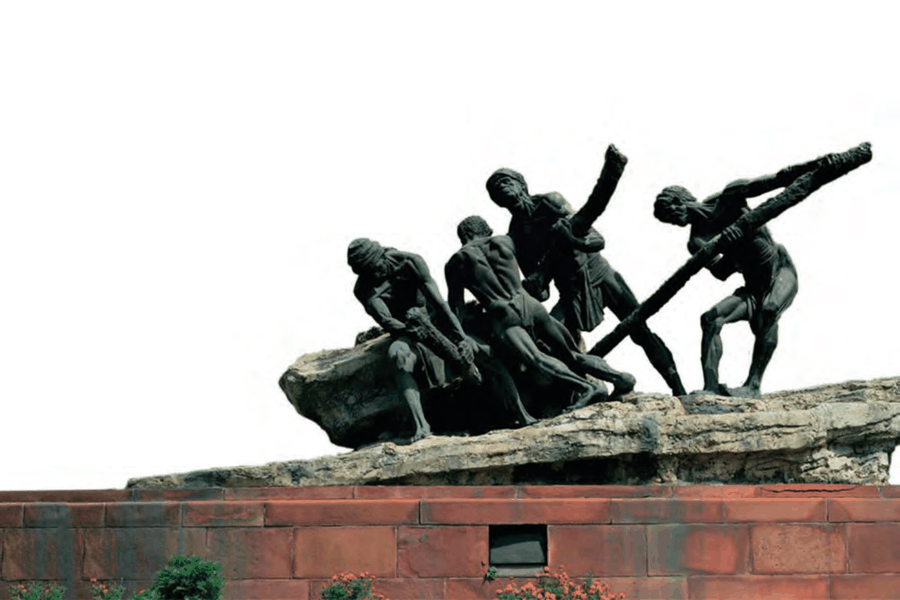
Debi Prasad Roy Chowdhury made the open-air bronze sculpture Triumph of Labour. Given below are four statements about this work:
(A) It shows four men trying to move a rock.
(B) It shows labour against the elements of nature, a well-known classical subject of the nineteenth century.
(C) Chowdhury dwelt on the strong musculature of his workers, revealing their bones and veins.
(D) The image of group labour is placed on a high pedestal, replacing the notion of portraits of kings.
Choose the correct answer from the options given below:
Answer & explanation
Correct answer: option 3
The correct answer is Option (3) → (A), (C) and (D) only
(A) It shows four men trying to move a rock. — Correct. The four men struggle with the rock to show the contribution of human labour in nation building.
(B) It shows labour against the elements of nature, a well-known classical subject of the nineteenth century. — Incorrect. Labour against nature is called a well-known romantic subject of the nineteenth century, not a classical one.
(C) Chowdhury dwelt on the strong musculature of his workers, revealing their bones and veins. — Correct. Through the muscles he showed the extreme physical effort of loosening a massive rock.
(D) The image of group labour is placed on a high pedestal, replacing the notion of portraits of kings. — Correct. The high pedestal gives the workers the place once kept for kings or British dignitaries.
NCERT (2026-27): “Triumph of Labour This is an open air large-scale sculpture in bronze made by Debi Prasad Roy Chowdhury (1899–1975). … It shows four men trying to move a rock, rendering the importance and contribution of human labour in nation building. … It is an image of labour against the elements of nature, a well-known romantic subject of the nineteenth century. Chowdhury loved to dwell on the strong musculature of his workers, revealing their bones, veins, flesh, etc. … The image of group labour is placed on a high pedestal, thereby, replacing the notion of portraits of kings or British dignitaries.”
|