
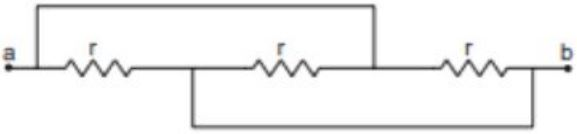
The equivalent resistance of the network shown in figure between the points a and b will be
Answer & explanation
Correct answer: option 2
The correct answer is Option (2) → \( r/3 \)
Points joined by a plain wire (no resistance) are at the same potential and can be treated as one point. Call the junction between the first and the second resistor P, and the junction between the second and the third resistor Q.
The upper wire joins a to Q, so Q is at the potential of a. The lower wire joins P to b, so P is at the potential of b.
The first resistor (a to P) is therefore between a and b.
The second resistor (P to Q) is between b and a.
The third resistor (Q to b) is between a and b.
So all three resistors are in parallel between a and b:
\( \displaystyle \frac{1}{R_{\mathrm{eq}}} = \frac{1}{r} + \frac{1}{r} + \frac{1}{r} = \frac{3}{r} \;\Rightarrow\; R_{\mathrm{eq}} = \frac{r}{3} \)