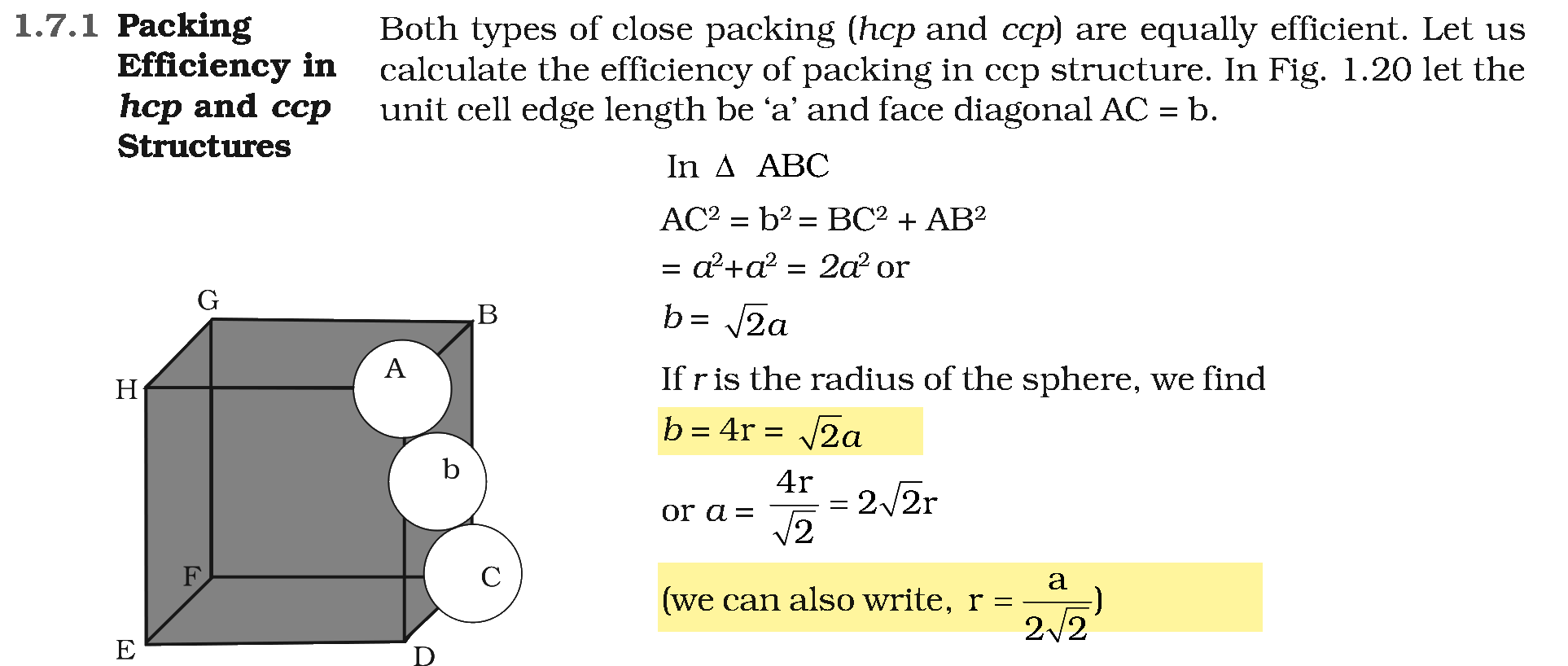
In a face centred cubic unit cell of close packed atoms, the radius of atom (r) is related to the edge length ‘a’ of the unit cell by the expression
Answer & explanation
Correct answer: option 3
The correct answer is Option (3) → \(r = \frac{a}{2\sqrt{2}}\)
In a face centred cubic (ccp) cell the atoms touch along the face diagonal, which is \( \sqrt{2}\,a \) long and spans four radii:
\( \displaystyle 4r = \sqrt{2}\,a \;\Rightarrow\; r = \frac{\sqrt{2}\,a}{4} = \frac{a}{2\sqrt{2}} \)
Why the other options are incorrect
Option (1) \(r = \frac{a}{\sqrt{2}}\) — Incorrect. This is twice the correct value; a/√2 is the distance between two touching atoms (2r) in fcc.
Option (2) \(r = \frac{a}{2}\) — Incorrect. This is the radius in a simple cubic cell, where atoms touch along the edge (a = 2r).
Option (4) \(r = \frac{\sqrt{3a}}{4}\) — Incorrect. √3a/4 is the radius in a body centred cubic cell, where atoms touch along the body diagonal (4r = √3 a).
Note: This question is from the pre-rationalised NCERT book (2022-23). The topic is not there in the latest NCERT book (2026-27), and it is also out of the CUET 2026 syllabus.
NCERT (Pre-rationalised edition, 2022-23):
Packing Efficiency in hcp and ccp Structures