When benzene diazonium chloride is heated with water, it gives the compound P which on further reaction with chloroform and aqueous sodium hydroxide /H3O+ gives the compound Q. Identify the compounds P and Q, respectively.
A. Benzene
B. Phenol
C. Salicylic acid
D. Salicylaldehyde
Choose the correct answer from the options given below:
Answer & explanation
Correct answer: option 3
The correct answer is Option (3) → B and D only
Two standard reactions are joined here.
(i) Hydrolysis of a diazonium salt. When an aqueous solution of benzenediazonium chloride is warmed, the –\( \ce{N2^{+}} \) group is replaced by –OH and nitrogen gas escapes. So P is phenol:
\( \displaystyle \ce{C6H5N2^+Cl^- + H2O} \xrightarrow{\text{warm}} \ce{C6H5OH + N2 ^ + HCl} \)
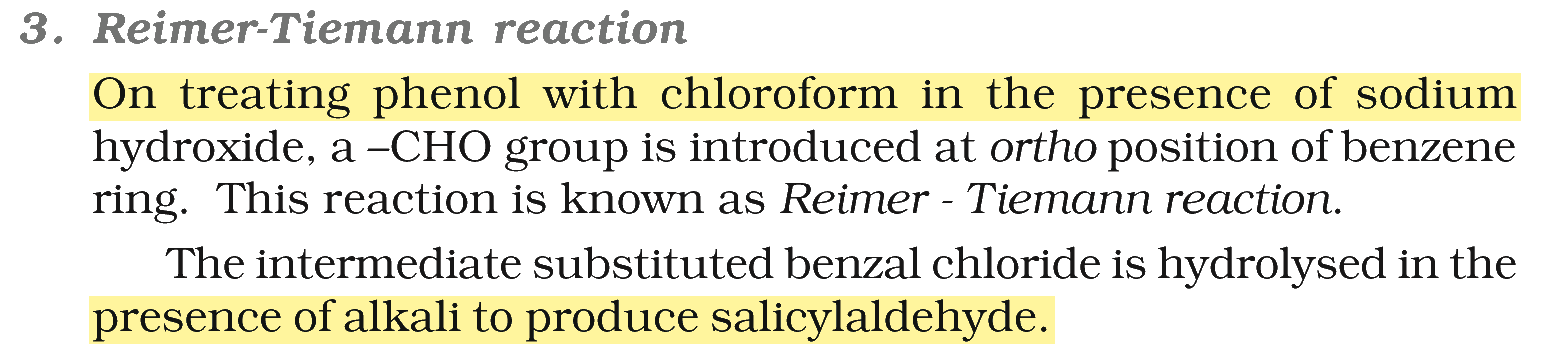
(ii) Reimer–Tiemann reaction. Phenol is treated with chloroform and aqueous sodium hydroxide. A –\( \ce{CHCl2} \) group enters the ring at the ortho position and is hydrolysed by the alkali to –CHO. Acidification then gives salicylaldehyde (2-hydroxybenzaldehyde), Q:
\( \displaystyle \ce{C6H5OH} \xrightarrow[\text{(ii) }\ce{H3O^+}]{\text{(i) }\ce{CHCl3}\text{, aq. }\ce{NaOH}} \ce{HOC6H4CHO} \)
NCERT (2026-27 edition):
From Diazonium Salts – “A diazonium salt is formed by treating an aromatic primary amine with nitrous acid (NaNO2 + HCl) at 273-278 K. Diazonium salts are hydrolysed to phenols by warming with water or by treating with dilute acids (Unit 9, Class XII).”
Reimer-Tiemann Reaction