
The reaction of glucose with nitric acid will yield
Answer & explanation
Correct answer: option 2
The correct answer is Option (2) → saccharic acid.
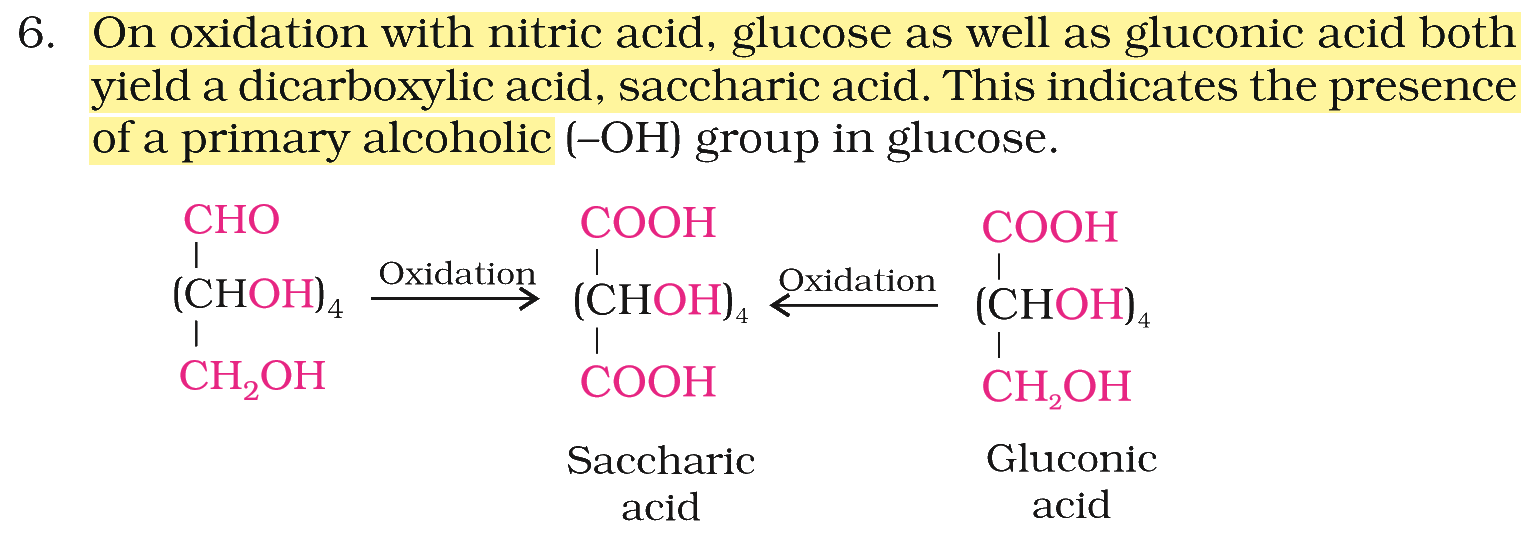
The open-chain structure of glucose has an aldehyde group (–CHO) at C1, four secondary –OH groups, and one primary alcoholic group (–CH2OH) at C6. Each reaction of glucose reveals one feature of this structure:
Bromine water (mild oxidant) oxidises only –CHO to –COOH, giving gluconic acid: this shows the aldehyde group.
Nitric acid (strong oxidant) oxidises both ends: –CHO and the primary –\( \ce{CH2OH} \) both become –COOH, giving the dicarboxylic acid saccharic acid (glucaric acid).
\( \displaystyle \underset{\text{glucose}}{\ce{OHC-(CHOH)4-CH2OH}} + \ce{3[O]} \xrightarrow{\ce{HNO3}} \underset{\text{saccharic acid}}{\ce{HOOC-(CHOH)4-COOH}} + \ce{H2O} \)
Only a primary alcohol group can be oxidised to –COOH without losing a carbon, so the formation of saccharic acid shows that glucose contains a primary alcoholic group. So the reaction of glucose with nitric acid yields saccharic acid.
Why the other options are incorrect
Option (1) gluconic acid. — Incorrect. It is formed with bromine water; it shows the aldehyde group, since only C1 is oxidised.
\( \displaystyle \ce{OHC-(CHOH)4-CH2OH} \xrightarrow{\ce{Br2}\text{ water}} \underset{\text{gluconic acid}}{\ce{HOOC-(CHOH)4-CH2OH}} \)
Option (3) gluconic acid + saccharic acid. — Incorrect. Nitric acid does not stop at gluconic acid; the product is saccharic acid alone.
Option (4) nitroglucose. — Incorrect. Nitric acid acts here as an oxidising agent, not as a nitrating agent, so no nitro compound forms.
NCERT (2026-27 edition):
Glucose – …
Note: The same/similar question has been asked in different years by NTA as per the details given below:
| 2026 | 2025 | 2024 | 2023 | 2022 |
|---|---|---|---|---|
| 29-05 S1 25-05 S1 | – | – | – | – |