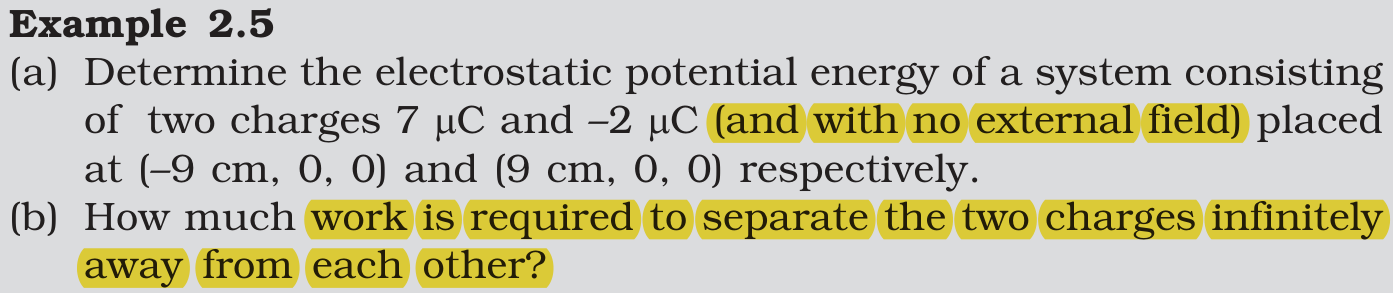
Two charges \( 5\,\mu\mathrm{C} \) and \( -2\,\mu\mathrm{C} \) (with no external field) are placed at \( (-9\,\mathrm{cm}, 0, 0) \) and \( (9\,\mathrm{cm}, 0, 0) \) respectively. The work required to separate the two charges infinitely away from each other is:
Answer & explanation
Correct answer: option 2
The correct answer is Option (2) → \( 0.5\,\mathrm{J} \)
The potential energy of a pair of charges is the work done in bringing them from infinity to their positions. The work required to separate them to infinity is the change in potential energy, from \( U \) to zero.
\( \displaystyle U = \frac{1}{4\pi\varepsilon_0}\,\frac{q_1 q_2}{r} \)
\( r = 9 - (-9) = 18\,\mathrm{cm} = 0.18\,\mathrm{m} \)
\( 1/4\pi\varepsilon_0 = 9\times10^{9}\,\mathrm{N\,m^{2}\,C^{-2}} \)
\( \displaystyle U = \frac{9\times10^{9} \times (5\times10^{-6}) \times (-2\times10^{-6})}{0.18} = \frac{-0.09}{0.18} = -0.5\,\mathrm{J} \)
\( W = U_{\infty} - U = 0 - (-0.5\,\mathrm{J}) = +0.5\,\mathrm{J} \)
The charges attract each other, so positive work must be done to pull them apart.
Note: NTA picked this question from an NCERT (2026-27) example and changed the figures. Do not ignore NCERT while practising numericals.
NCERT (2026-27):
Potential Energy of a System of Charges – …