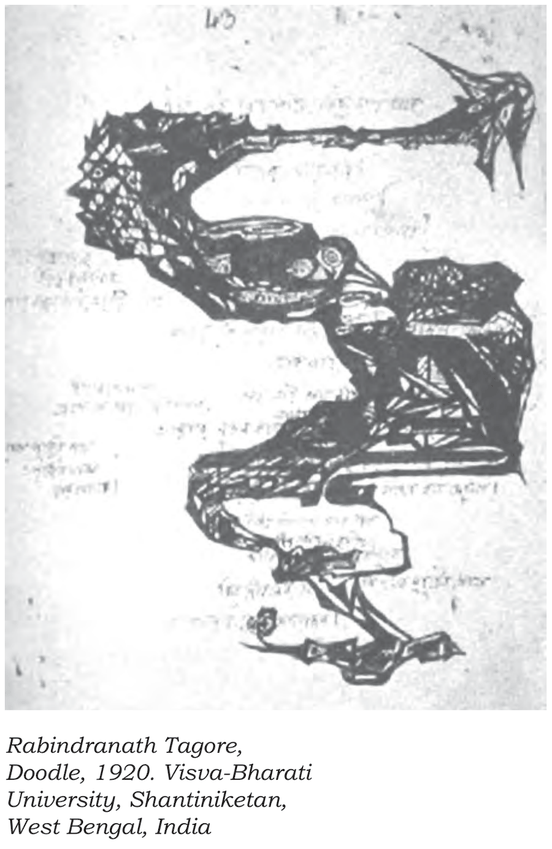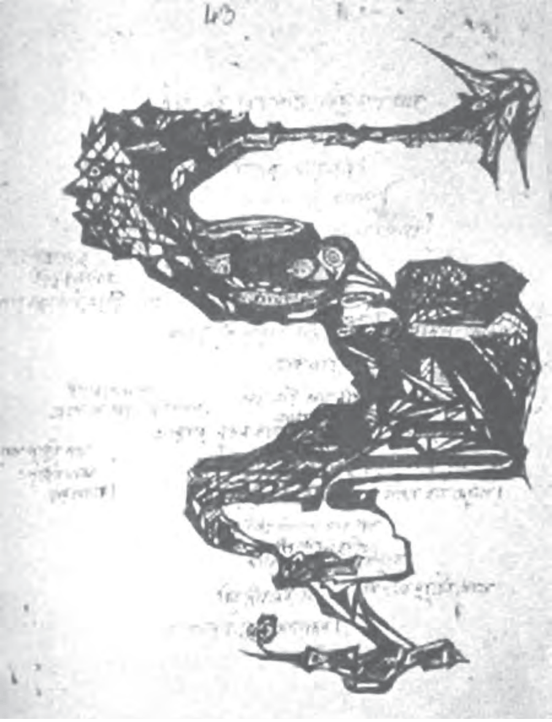
Rabindranath Tagore turned to visual art quite late in life. How did he develop the unique calligraphic style seen in works such as the one shown above?
Answer & explanation
Correct answer: option 3
The correct answer is Option (3) → From patterns made out of doodles and crossed-out words
Option (1) From the elegant style of the Bengal School — Incorrect. His small visual world was a complete departure from the elegant and delicate style of the Bengal School.
Option (2) From Mughal and Pahari miniatures — Incorrect. These miniatures inspired the Bengal School, the style Rabindranath moved away from.
Option (3) From patterns made out of doodles and crossed-out words — Correct. While writing poems, he made patterns out of doodles and built a calligraphic style out of crossed out words.
Option (4) From the geometrical facets of Picasso’s Cubism — Incorrect. Picasso invented Cubism using geometrical facets. Rabindranath’s style grew out of his writing, not out of Cubism.
Note: This topic was not named in the CUET 2026 syllabus, but it was part of the NCERT chapter. In 2025 and 2026, NTA also asked questions on topics in NCERT that the CUET syllabus did not name. So our mocks have questions from every part of the NCERT chapter, to give you enough practice. Read the whole chapter, not only the sub-topics named in the syllabus.
NCERT (2026-27): “Introduction to Modernism in India …Rabindranath Tagore turned to visual art quite late in life. While writing poems, he would often make patterns out of doodles and developed a unique, calligraphic style out of crossed out words. Some of these were turned into human faces and landscapes, which floated captivatingly in his poems. His palette was limited with black, yellow ochre, reds and browns. However, Rabindranath created a small visual world that was a complete departure from the more elegant and delicate style of the Bengal School, which often drew inspiration from Mughal and Pahari miniatures along with Ajanta frescoes.”
|