
CUETMOCK
  • Pricing
  • Mentors
Log inStart freeStart free mocks→

First test, then trust

Try a free CUET mock test.

Join 5,00,000+ students who rehearsed exam day on the exact NTA screen before sitting CUET. On the web and on Android.

Start free mocks →Get the Android app
CUETMOCK

India's #1 CUET Mock Test Platform. Original NCERT-based questions on the exact NTA exam screen — trusted by 5,00,000+ students since CUET 2022.

Get it onGoogle PlayScan to download the CUETMOCK app

Mock tests

  • CUET mock test series
  • Browse all papers
  • Commerce mocks
  • Humanities (Arts) mocks
  • Science mocks
  • Languages & GAT mocks
  • Free practice questions
  • Pricing

Resources

  • CUET exam guide
  • CUET syllabus
  • Universities accepting CUET
  • Expert blogs
  • News & notifications
  • Webinars & counselling
  • CUET score calculator
  • How we estimate your rank
  • FAQs

Company

  • About us
  • Our leadership & team
  • Our toppers
  • Mentors
  • For schools
  • Contact us
  • Terms
  • Privacy
  • Refund policy

Talk to us

+91 7696 6630 56info@cuetmock.comWhatsApp us

Our other platforms

  • JEE Mock — For IIT-JEE aspirants
  • NEET Mock — For NEET aspirants

Newsletter

Exam updates, study material and offers — no spam.

© 2026 NYC Ventures Pvt. Ltd.

701-702, Royal Business Park, Zirakpur, Punjab - 140603

  • Terms of use
  • Privacy policy
  • Refund policy
  • Contact us

iCUETMOCK is an independent preparation platform, not affiliated with the National Testing Agency (NTA). Always check exam details on the official NTA website.

  • Home
  • Mock tests
  • CUET guide
  • Pricing
  • Log in
Home/Practice questions/Physics
PhysicsElectrostatic Potential and Capacitance

Three very large plates are given charges as shown in the figure. If…

Three very large plates are given charges as shown in the figure. If the cross-sectional area of each plate is the same, then the final charge distribution on the surface of the plates a, b, c, d, e, f is
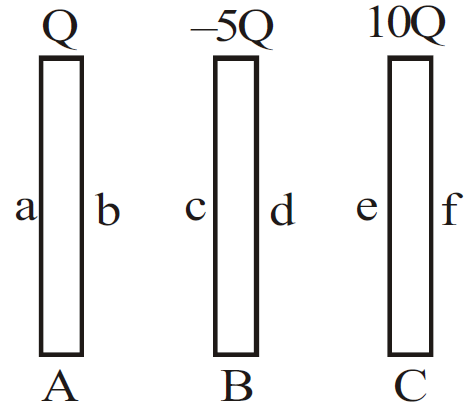
Answer & explanation+

Correct answer: option 4

Using the conservation of charge principle, distribute the charge on all the surfaces of the plates a, b, c, d, e, and f. Then use the concept, electric field is zero inside the plates.

Advertisement

Practise more on Electrostatic Potential and Capacitance

Chapter-wise mocks on the real NTA exam screen, with solutions and your rank. Your first mocks are free.

Start free mocks →

Advertisement

Next questions

  1. Three statements are given, followed by three conclusions numbered I, II and III. Assuming the statements to be true, even if they seem to…General Aptitude Test · Verbal Reasoning
  2. An amine, R–NH2, accepts a proton from water as shown below. R-NH2 + H2O R-NH3^+ + OH^- Which of the following expressions gives the Kb of…Chemistry · Organic: Amines
  3. Five persons, F, J, N, R and V, are sitting around a circular table facing towards the centre (not necessarily in the same order). J is to…General Aptitude Test · Verbal Reasoning
  4. In a typical angiosperm embryo sac, the egg apparatus consists of:Biology · Sexual Reproduction in Flowering Plants
  5. The mandate of Arbitral Tribunal terminates:Legal Studies · Arbitration, Tribunal Adjudication and Alternate Dispute resolution
  6. सूची-I को सूची-II से सुमेलित कीजिए :सूची-I शब्दसूची-II शब्द-भेद(A) अड़ंगा(I) विदेशी(B) मुख(II) तत्सम(C) काम(III) देशज(D) दफ़्तर(IV) तद्भवनी…Hindi · शब्द भेद (तत्सम, तद्भव, देशज, विदेशज)
  7. How many of the following nuclides are isotones of ^198_80Hg ? ^197_79Au , ^198_78Pt , ^199_80Hg , ^196_78Pt , ^198_79Au , ^199_81TlPhysics · Nuclei
  8. The assessment of damage that has already been done by a stressful event is called _______________ according to Lazarus and his colleagues.Psychology · Meeting Life Challenges
  9. The Demand equations of the two consumers are given asd1(p) = 10 − 2pd2(p) = 20 − 8pWhere d is the demand and p is the priceCalculate the m…Economics · Micro Economics: Theory of Consumer behaviour
  10. For a first-order reaction at 500 K, the rate constant is 4.0 × 10⁻⁵ s−1 and the Arrhenius factor (A) is 4.0 × 10¹³ s−1. What is the activa…Chemistry · Physical: Chemical Kinetics