
An amine, R–NH2, accepts a proton from water as shown below.
\( \ce{R-NH2 + H2O <=> R-NH3^+ + OH^-} \)
Which of the following expressions gives the Kb of the amine?
Answer & explanation
Correct answer: option 4
The correct answer is Option (4) → \( K_b = \frac{[\ce{R-NH3^+}][\ce{OH^-}]}{[\ce{R-NH2}]} \)
The equilibrium constant K of the reaction has the products on top and the reactants below, water included:
\( \displaystyle K = \frac{[\ce{R-NH3^+}][\ce{OH^-}]}{[\ce{R-NH2}][\ce{H2O}]} \)
Water is present in large excess, so its concentration stays practically constant. It is taken to the left side and joined with K; the product K[H2O] is the base dissociation constant, Kb:
\( \displaystyle K[\ce{H2O}] = K_b = \frac{[\ce{R-NH3^+}][\ce{OH^-}]}{[\ce{R-NH2}]} \)
\( \displaystyle \mathrm{p}K_b = -\log K_b \)
A larger Kb, or a smaller pKb, means a stronger base.
Option (1) \( K_b = \frac{[\ce{R-NH3^+}][\ce{OH^-}]}{[\ce{R-NH2}][\ce{H2O}]} \) — Incorrect. This is K, not Kb; Kb does not carry the [H2O] term.
Option (2) \( K_b = \frac{[\ce{R-NH2}]}{[\ce{R-NH3^+}][\ce{OH^-}]} \) — Incorrect. This is the expression upside down, that is 1/Kb.
Option (3) \( K_b = \frac{[\ce{R-NH2}][\ce{H^+}]}{[\ce{R-NH3^+}]} \) — Incorrect. This describes R–NH3+ giving up a proton, which is the reverse kind of process, not the amine accepting a proton from water.
NCERT (2026-27 edition):
9.6 Chemical Reactions – “Basic character of amines can be better understood in terms of their Kb and pKb values as explained below:”
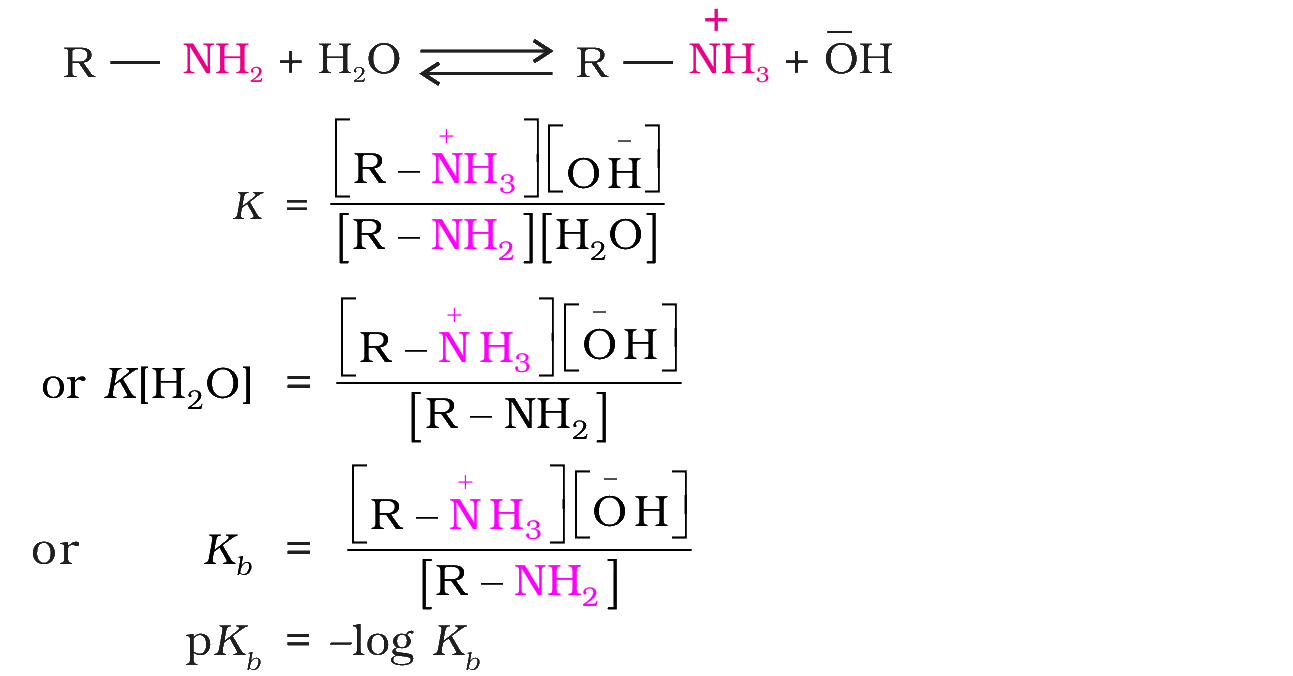
“Larger the value of Kb or smaller the value of pKb, stronger is the base.”