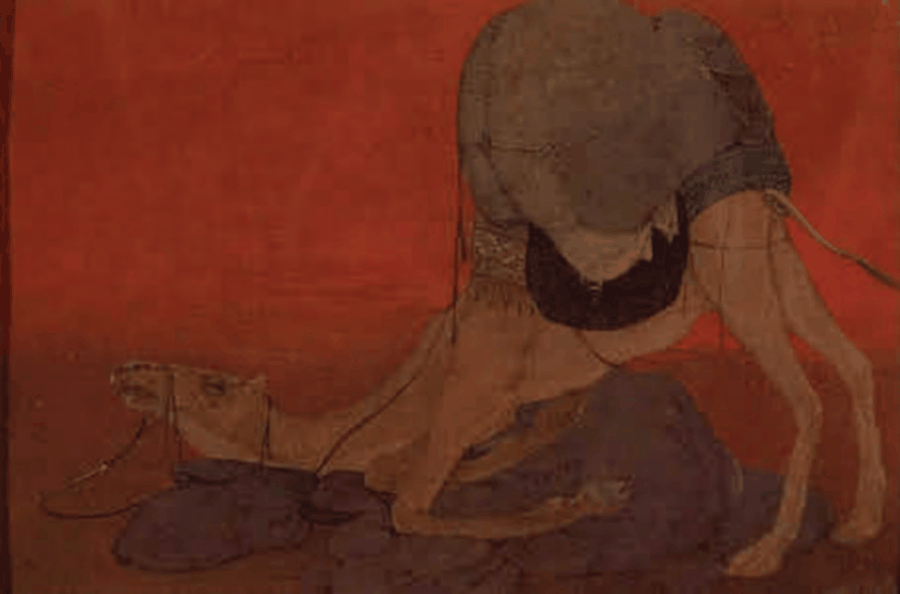
These statements are about Abanindranath Tagore’s painting Journey’s End.
(A) It shows the influence of Mughal and Pahari miniatures.
(B) It is painted in tempera.
(C) A collapsed camel is shown against a red background of dusk.
(D) Its hazy wash effects suggest the beginning of a new life.
Choose the correct answer from the options given below:
Answer & explanation
Correct answer: option 3
The correct answer is Option (3) → (A) and (C) only
(A) It shows the influence of Mughal and Pahari miniatures. — Correct. It shows this influence and Abanindranath’s wish to create an Indian style.
(B) It is painted in tempera. — Incorrect. It is a watercolour. Thick tempera was used by Nandalal Bose in Tiller of the Soil.
(C) A collapsed camel is shown against a red background of dusk. — Correct. The fallen camel at dusk stands for the end of a journey through the end of a day.
(D) Its hazy wash effects suggest the beginning of a new life. — Incorrect. The hazy, atmospheric wash suggests the end of a life, not a beginning.
NCERT (2026-27): “Abanindranath Tagore and E. B. Havell …Havell and Abanindranath Tagore designed a curriculum to include and encourage technique and themes in Indian art traditions. Abanindranath’s Journey’s End shows the influence of Mughal and Pahari miniatures, and his desire to create an Indian style in painting.” “Journey’s End Made by Abanindranath Tagore (1871–1951) in 1913, this painting is in watercolour. …The wash technique yields a soft, misty and impressionistic landscape. This quality of hazy and atmospheric effects of the wash are utilised to be suggestive or evocative of an end of a life. In this painting, a collapsed camel is shown in red background of dusk and in that sense it personifies the end of a journey through the end of a day.…”
|