Statement I: Auric chloride (AuCl3) solution cannot be stored in a vessel made of copper, iron, nickel, chromium, zinc or tin.
Statement II: Copper is a weaker reducing agent than zinc.
Answer & explanation
Correct answer: option 2
The correct answer is Option (2) → Both Statement I and Statement II are correct but Statement II is not the correct explanation of Statement I.
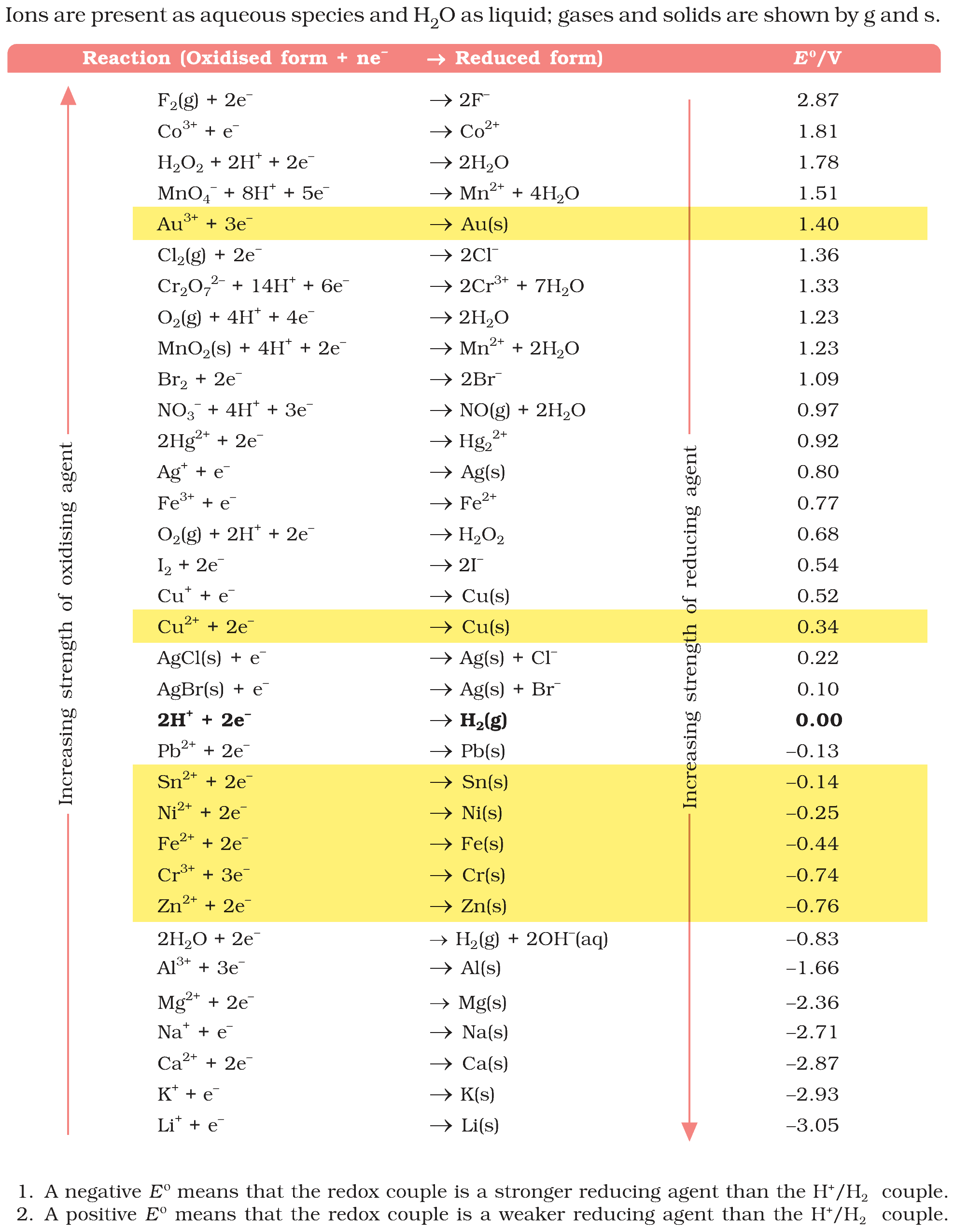
The lower the standard electrode potential of a metal, the stronger it is as a reducing agent. A metal reduces the ions of any metal that has a higher E°.
Statement I: Auric chloride (AuCl3) solution cannot be stored in a vessel made of copper, iron, nickel, chromium, zinc or tin. — True. E°(\( \ce{Au^3+} \)/Au) = +1.40 V is higher than the E° of every one of these metals (Cu +0.34 V, Sn −0.14 V, Ni −0.25 V, Fe −0.44 V, Cr −0.74 V, Zn −0.76 V). Each metal therefore reduces the gold ions: the vessel dissolves and gold is deposited, for example:
\( \displaystyle \ce{3Cu(s) + 2Au^3+(aq) -> 3Cu^2+(aq) + 2Au(s)} \)
Statement II: Copper is a weaker reducing agent than zinc. — True. E°(\( \ce{Cu^2+} \)/Cu) = +0.34 V lies above E°(\( \ce{Zn^2+} \)/Zn) = −0.76 V, so copper has the lower reducing power.
Why Statement II does not explain Statement I?
Statement I depends on each vessel metal standing below gold in the series.
Comparing copper with zinc says nothing about gold ions, so Statement II is a true fact but not the reason for Statement I.
NCERT (2026-27 edition):
2.2.1 Measurement of Electrode Potential – “… It may be seen that as we go from top to bottom in Table 2.1 the standard electrode potential decreases and with this, decreases the oxidising power of the species on the left and increases the reducing power of the species on the right hand side of the reaction.”
Table 2.1: Standard Electrode Potentials at 298 K