Which one of the following factors does not affect Hardy-Weinberg equilibrium?
Answer & explanation
Correct answer: option 4
The correct answer is Option (4) → Use and disuse of organs
The Hardy-Weinberg principle says that the frequency of the alleles of a gene in a population stays fixed from one generation to the next. For two alleles with frequencies p and q:
\( \displaystyle p^2 + 2pq + q^2 = 1 \)
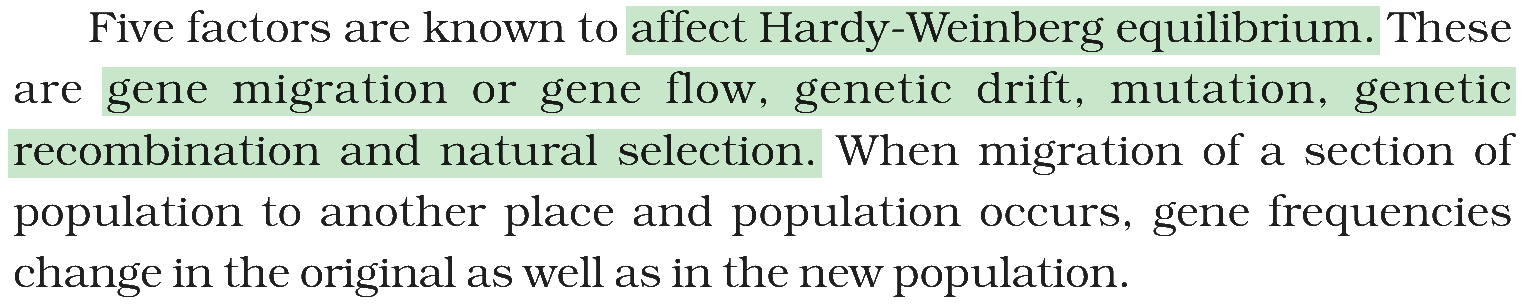
Five factors disturb this equilibrium: gene migration (gene flow), genetic drift, mutation, genetic recombination and natural selection.
(1) Natural selection — A factor that affects Hardy-Weinberg equilibrium. It changes allele frequencies by favouring some individuals.
(2) Genetic recombination — A factor that affects Hardy-Weinberg equilibrium. It makes new combinations of alleles.
(3) Mutation — A factor that affects Hardy-Weinberg equilibrium. It adds new alleles to the population.
(4) Use and disuse of organs — Not a factor that affects Hardy-Weinberg equilibrium. This is Lamarck’s idea that organs grow stronger with use and weaker without it. It does not change the alleles in the gene pool, and it is not one of the five factors.
NCERT Extract:
Hardy-Weinberg Principle – …