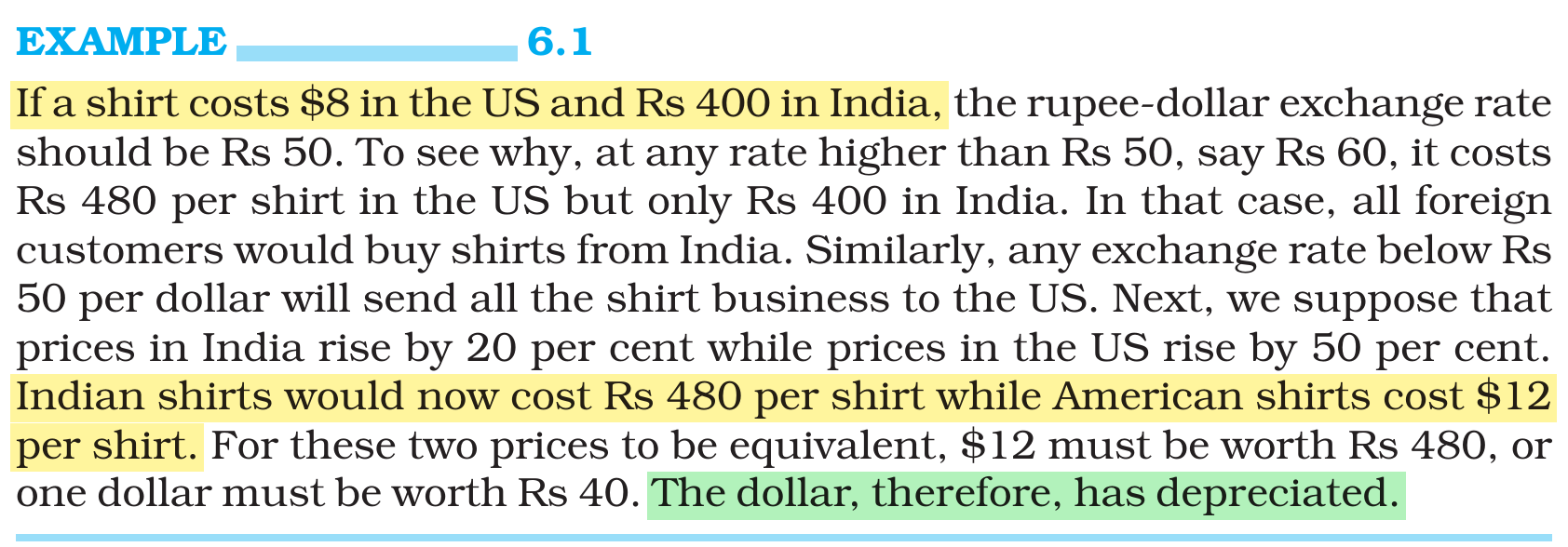
The cost of a bag increased from $8 to $12 in the US and ₹400 to ₹480 in India. What effect it has on the dollar in respect to exchange price?
Answer & explanation
Correct answer: option 3
The correct answer is Option (3) → Depreciated
Given:
Price in the US, before: $8
Price in the US, after: $12
Price in India, before: ₹400
Price in India, after: ₹480
The same product should cost the same in both countries. So the exchange rate moves to reflect the two price levels. This idea is called purchasing power parity. The rate is the rupee price divided by the dollar price.
Before: 400 ÷ 8 = ₹50 per dollar
After: 480 ÷ 12 = ₹40 per dollar
A dollar now buys fewer rupees, so the dollar has lost value: it has depreciated. Devaluation and revaluation are government actions under a fixed exchange rate.
Note: This question is the example of the shirt in the chapter ‘Open Economy Macroeconomics’ of the NCERT book, with the same prices. The shirt has become a bag.
NCERT (2026-27): “Exchange Rates in the Long Run The purchasing Power (PPP) theory is used to make long-run predictions about exchange rates in a flexible exchange rate system. According to the theory, as long as there are no barriers to trade like tariffs (taxes on trade) and quotas (quantitative limits on imports), exchange rates should eventually adjust so that the same product costs the same whether measured in rupees in India, or dollars in the US, yen in Japan and so on, except for differences in transportation. Over the long run, therefore, exchange rates between any two national currencies adjust to reflect differences in the price levels in the two countries.… … In a fixed exchange rate system, when some government action increases the exchange rate (thereby, making domestic currency cheaper) is called Devaluation. On the other hand, a Revaluation is said to occur, when the Government decreases the exchange rate (thereby, making domestic currency costlier) in a fixed exchange rate system.”
|