CUETMOCK
  • Pricing
  • Mentors
Log inStart freeStart free mocks→

First test, then trust

Try a free CUET mock test.

Join 5,00,000+ students who rehearsed exam day on the exact NTA screen before sitting CUET. On the web and on Android.

Start free mocks →Get the Android app
CUETMOCK

India's #1 CUET Mock Test Platform. Original NCERT-based questions on the exact NTA exam screen — trusted by 5,00,000+ students since CUET 2022.

Get it onGoogle PlayScan to download the CUETMOCK app

Mock tests

  • CUET mock test series
  • Browse all papers
  • Commerce mocks
  • Humanities (Arts) mocks
  • Science mocks
  • Languages & GAT mocks
  • Free practice questions
  • Pricing

Resources

  • CUET exam guide
  • CUET syllabus
  • Universities accepting CUET
  • Expert blogs
  • News & notifications
  • Webinars & counselling
  • CUET score calculator
  • How we estimate your rank
  • FAQs

Company

  • About us
  • Our leadership & team
  • Our toppers
  • Mentors
  • For schools
  • Contact us
  • Terms
  • Privacy
  • Refund policy

Talk to us

+91 7696 6630 56info@cuetmock.comWhatsApp us

Our other platforms

  • JEE Mock — For IIT-JEE aspirants
  • NEET Mock — For NEET aspirants

Newsletter

Exam updates, study material and offers — no spam.

© 2026 NYC Ventures Pvt. Ltd.

701-702, Royal Business Park, Zirakpur, Punjab - 140603

  • Terms of use
  • Privacy policy
  • Refund policy
  • Contact us

iCUETMOCK is an independent preparation platform, not affiliated with the National Testing Agency (NTA). Always check exam details on the official NTA website.

  • Home
  • Mock tests
  • CUET guide
  • Pricing
  • Log in
Home/Practice questions/General Aptitude Test
General Aptitude TestVerbal ReasoningSyllogism

In the following question below are given some statements followed by…

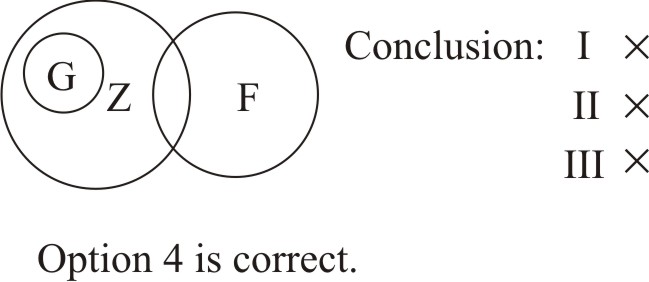
In the following question below are given some statements followed by some conclusions based on those statements. Taking the given statements to be true even if they seem to be at variance from commonly known facts. Read all the conclusions and then decide which of the given conclusion logically follows the given statements.

Statements:
I. Some Z are F.
II. All G are Z.

Conclusion:
I. No F is G.
II. Some G are not F.
III. No F is Z.

Answer & explanation+

Correct answer: option 4

Advertisement

Practise more on Verbal Reasoning

Chapter-wise mocks on the real NTA exam screen, with solutions and your rank. Your first mocks are free.

Start free mocks →

Advertisement

Next questions

  1. What is the probability of the random arrangement of letters in the word "UNIVERSITY" and two I's should come together?General Aptitude Test · Quantitative Reasoning
  2. Which of the following methods can be used to separate the volatile component (solvent) from its non-volatile solute in a solution?General Aptitude Test · General Knowledge
  3. Find the missing figure.Problem figureGeneral Aptitude Test · Non-Verbal Reasoning
  4. If in a certain code, the word MILITARY is written as 01213456, then in the same code the word MAIL will be written as.General Aptitude Test · Verbal Reasoning
  5. Which of the following relations on the set A = {1, 2, 3} are equivalence? (A) R = {(1, 1), (2, 2), (1, 2), (2, 1)} (B) R = {(1, 1), (2, 2)…Maths. Section B1 · Relations and Functions
  6. In which Five Year Plan, the Hill Area Development Programmes were initiated in India?Geography · India-People and Economy: Planning and Sustainable development in Indian Context
  7. Select the option figure in which the given figure (X) is embedded as its part (rotation is NOT allowed). (x)General Aptitude Test · Verbal Reasoning
  8. Select the option that is related to the third term in the same way as the second term is related to the first term and the sixth term is r…General Aptitude Test · General Ability
  9. In 1526, the battle of Panipat was fought between ________ .General Aptitude Test · General Knowledge
  10. Which of the following statement are correct?A. Magnetisation of a sample is equal to its magnetic moment per unit volume.B. For measuring…Physics · Moving Charges and Magnetism