
Proteins are most abundant biomolecules of the living organism. The main source of proteins are milk, cheese, pulses, peanuts, fish meat etc. Amino acids are building block of proteins. Amino acids contain amino (–NH2) and carboxyl (–COOH) functional groups. Depending upon the relative position of amino group with respect to carboxyl group, the amino acids can be classified as α, β, γ, δ and so on. Only alpha amino acid are obtained on hydrolysis of protein. Amino acids are classified as acidic, or basic or neutral depending upon the relative number of amino and carboxyl group in their molecule.
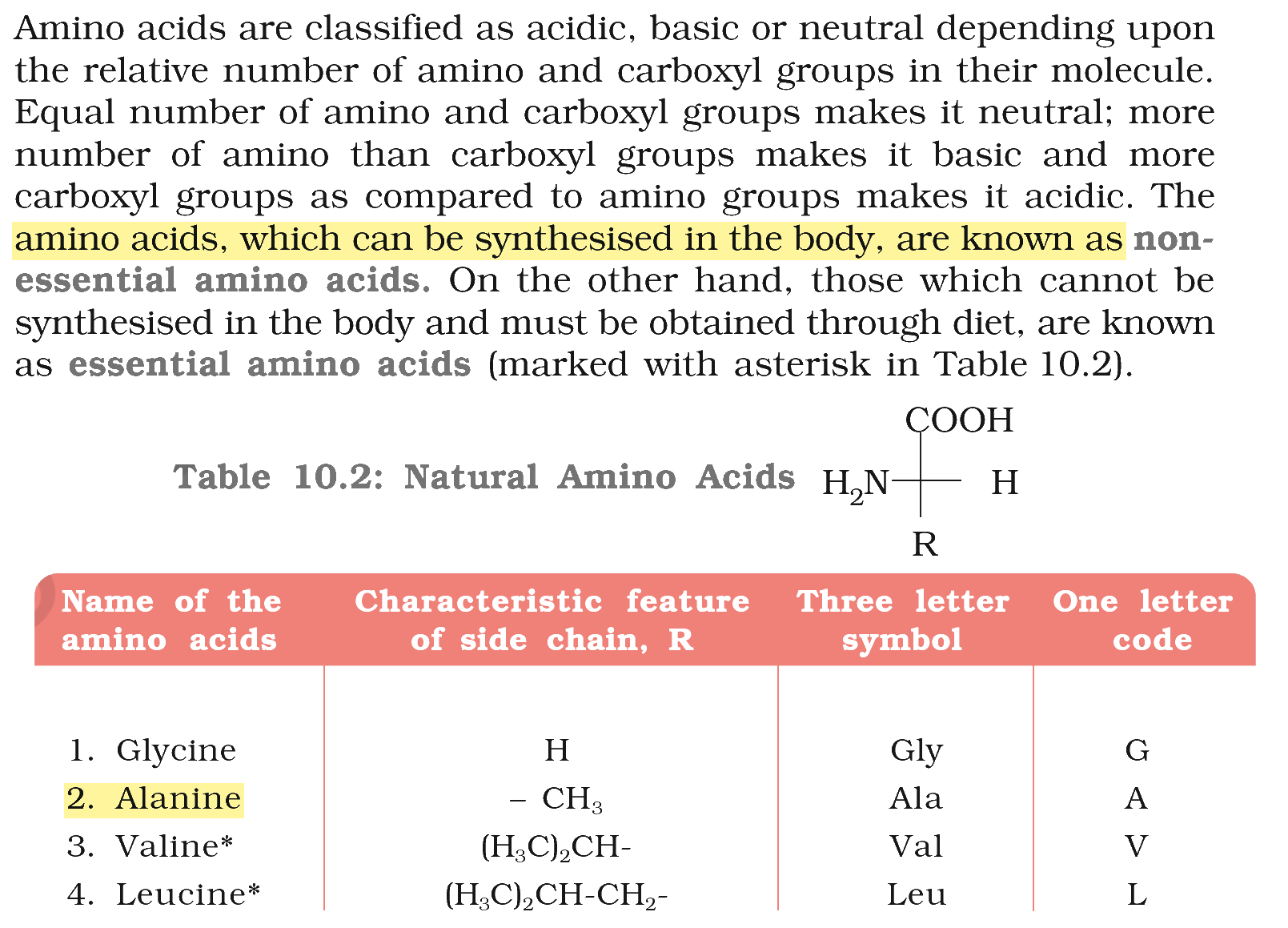
Amino acids which can be synthesised in the body are known as non-essential amino acids. On the other hand, those which can not be synthesised in the body and must be obtained through diet are known as essential amino acids. Proteins are condensation product of amino acids which are linked through peptide bond or peptide linkage.
Proteins can be classified into two types on the basis of their molecular shape. (a) Fibrous and (b) Globular proteins. Proteins found in a biological system with unique three-dimensional structure and biological activity is called a native protein. When a protein in its native form is subjected to physical changes, such as change in temperature, or chemical changes, such as change in pH, hydrogen bonds are disturbed. As a result, globules unfold, helices uncoil, and protein loses its biological activity. This is called denaturation of protein.
Which among the following is a non-essential amino acid?
Answer & explanation
Correct answer: option 3
The correct answer is Option (3) → Alanine
Amino acids are classified by whether the body can make them:
Non-essential amino acids can be synthesised in the body: glycine, alanine, serine, cysteine, tyrosine, proline, aspartic acid, glutamic acid, asparagine, glutamine.
Essential amino acids cannot be synthesised and must come from the diet: valine, leucine, isoleucine, lysine, arginine, histidine, threonine, methionine, phenylalanine, tryptophan.
So the non-essential amino acid among the options is alanine.
NCERT (2026-27 edition):
Classification of Amino Acids – “… The amino acids, which can be synthesised in the body, are known as non-essential amino acids. On the other hand, those which cannot be synthesised in the body and must be obtained through diet, are known as essential amino acids (marked with asterisk in Table 10.2).”
Note: The same/similar question has been asked in different years by NTA as per the details given below:
| 2026 | 2025 | 2024 | 2023 | 2022 |
|---|---|---|---|---|
| 07-06 S2 | 14-05 S2 | – | – | – |