A man speaks the truth 8 out of 10 times. A die is tossed. He reports that it was 5. What is the probability that it was actually 5?
Answer & explanation
Correct answer: option 2
The correct answer is Option (2) → \( \displaystyle\frac{4}{9} \)
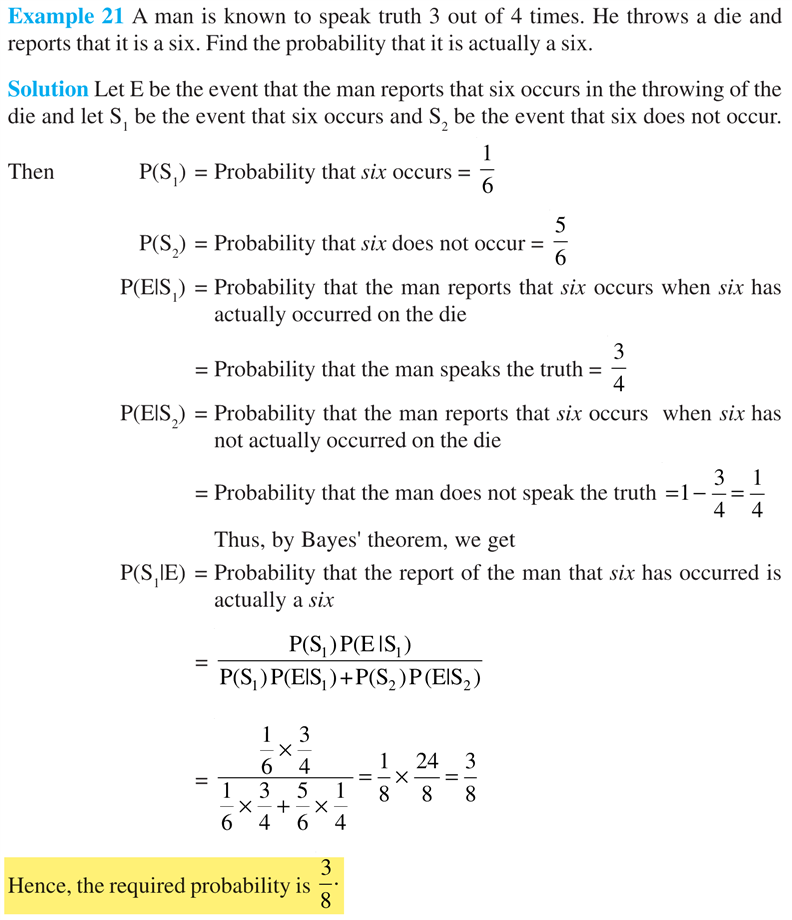
This asks for the probability of a cause (the die showed 5) after the result (he reports 5) is known, so Bayes’ theorem applies.
Let \( E_1 \) = the die shows 5, \( E_2 \) = the die does not show 5, and A = he reports 5.
\( \displaystyle P(E_1)=\frac{1}{6},\quad P(E_2)=\frac{5}{6} \)
\( \displaystyle P(A|E_1)=P(\text{truth})=\frac{8}{10}=\frac{4}{5} \)
\( \displaystyle P(A|E_2)=P(\text{lie})=\frac{1}{5} \)
\( \displaystyle P(E_1|A)=\frac{P(E_1)P(A|E_1)}{P(E_1)P(A|E_1)+P(E_2)P(A|E_2)} \)
\( \displaystyle =\frac{\frac{1}{6}\cdot\frac{4}{5}}{\frac{1}{6}\cdot\frac{4}{5}+\frac{5}{6}\cdot\frac{1}{5}} \)
\( \displaystyle =\frac{\frac{4}{30}}{\frac{4}{30}+\frac{5}{30}} \)
\( \displaystyle =\frac{4}{9} \)
Shortcut: Bayes’ theorem is a ratio. Compare the two ways the report can arise:
\( \displaystyle (\text{really 5}):(\text{not 5})=\frac{1}{6}\cdot\frac{4}{5}:\frac{5}{6}\cdot\frac{1}{5} \)
\( \displaystyle =4:5 \)
So the required probability is \( \frac{4}{4+5}=\frac{4}{9} \).
NCERT (2026-27 edition):
Bayes Theorem