Read the passage and answer the questions:
Revolt of 1857: Issues of Rumours
We cannot understand the power of rumours and prophecies in history by checking whether they are factually correct or not. We need to see what they reflect about the minds of people who believed them – their fears and apprehensions, their faiths and convictions. Rumours circulate only when they resonate with the deeper fears and suspicions of people. The rumours in 1857 begin to make sense when seen in the context of the policies the British pursued from the late 1820s. As you know, from that time, under the leadership of Lord William Bentinck, the British adopted policies aimed at “reforming” Indian society by introducing Western education, Western ideas and Western institutions. With the cooperation of sections of Indian society they set up English-medium schools, colleges and universities which taught Western sciences and the liberal arts. The British established laws to abolish customs like sati and to permit the remarriage of Hindu widows. On a variety of pleas, like misgovernment and the refusal to recognise adoption, the British annexed not only Awadh, but many other kingdoms and principalities like Jhansi and Satara. Once these territories were annexed, the British introduced their own system of administration, their own laws and their own methods of land settlement and land revenue collection. The cumulative impact of all this on the people of North India was profound. It seemed to the people that all that they cherished and held sacred – from kings and socio-religious customs to patterns of landholding and revenue payment – was being destroyed and replaced by a system that was more impersonal, alien and oppressive. This perception was aggravated by the activities of Christian missionaries. In such a situation of uncertainty, rumours spread with remarkable swiftness.
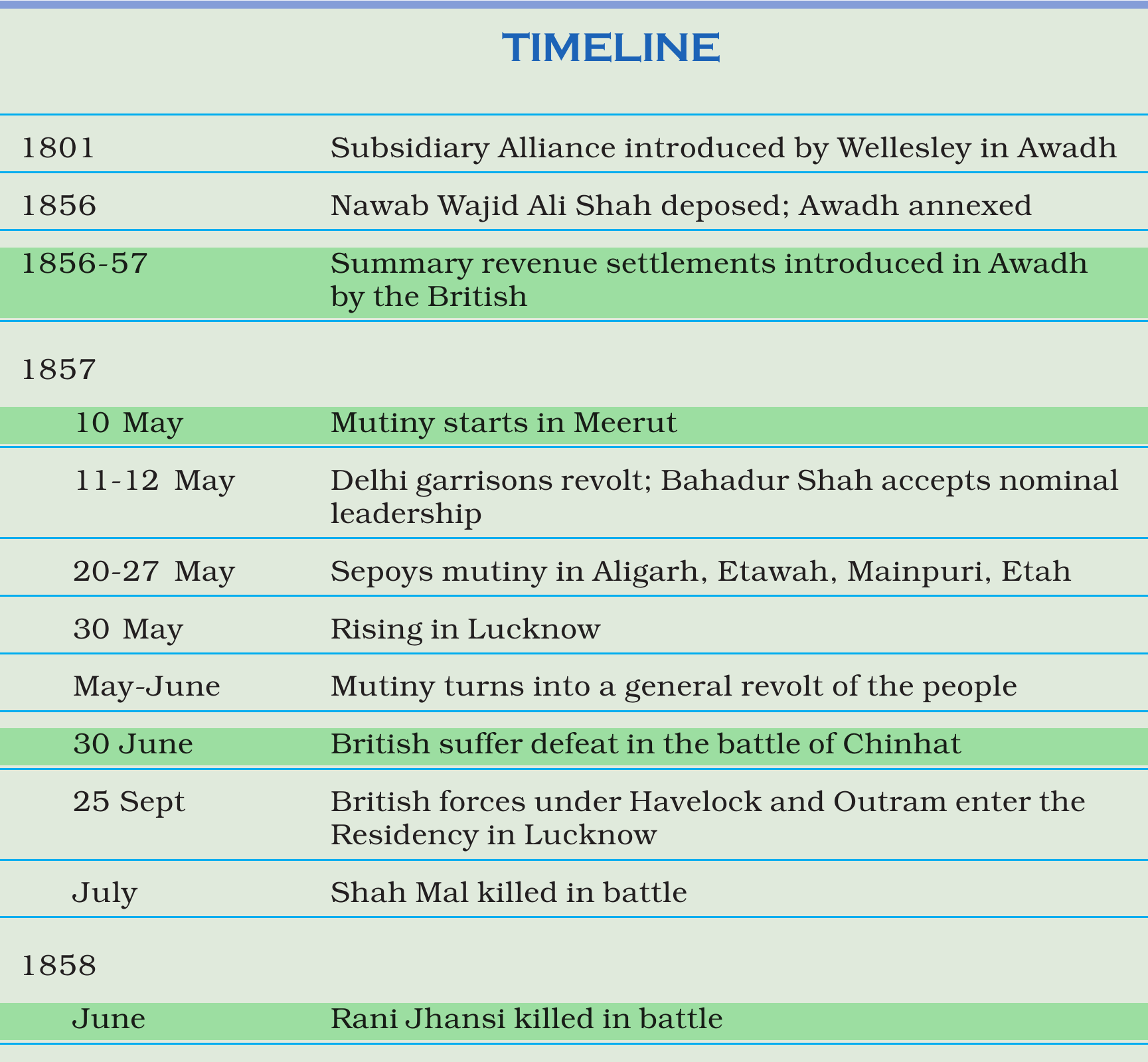
Arrange the following events in chronological order:
A. Summary revenue settlement introduced in Awadh by the British
B. British suffer defeat at the battle of Chinhat
C. Mutiny Starts in Meerut
D. Rani Jhansi killed in battle
Choose the correct answer from the options given below:
Answer & explanation
Correct answer: option 2
The correct answer is Option (2) → A, C, B, D
(A) Summary revenue settlement introduced in Awadh by the British — 1856-57. After Awadh was annexed in 1856, the British brought in the Summary Settlement, which removed the taluqdars from their lands wherever possible.
(C) Mutiny starts in Meerut — 10 May 1857. The sepoys of the Meerut cantonment broke out in mutiny, and the revolt spread from there.
(B) British suffer defeat at the battle of Chinhat — 30 June 1857, near Lucknow.
(D) Rani Jhansi killed in battle — June 1858.
NCERT (2025-26): “2.3 Firangi raj and the end of a world … After annexation, the first British revenue settlement, known as the Summary Settlement of 1856, was based on the assumption that the taluqdars were interlopers with no permanent stakes in land: they had established their hold over land through force and fraud.…”
|