
CUETMOCK
  • Pricing
  • Mentors
Log inStart freeStart free mocks→

First test, then trust

Try a free CUET mock test.

Join 5,00,000+ students who rehearsed exam day on the exact NTA screen before sitting CUET. On the web and on Android.

Start free mocks →Get the Android app
CUETMOCK

India's #1 CUET Mock Test Platform. Original NCERT-based questions on the exact NTA exam screen — trusted by 5,00,000+ students since CUET 2022.

Get it onGoogle PlayScan to download the CUETMOCK app

Mock tests

  • CUET mock test series
  • Commerce mocks
  • Humanities (Arts) mocks
  • Science mocks
  • Languages & GAT mocks
  • Free practice questions
  • Pricing

Resources

  • CUET exam guide
  • CUET syllabus
  • Universities accepting CUET
  • Expert blogs
  • News & notifications
  • Webinars & counselling
  • CUET score calculator
  • How we estimate your rank
  • FAQs

Company

  • About us
  • Our leadership & team
  • Our toppers
  • Mentors
  • For schools
  • Contact us
  • Terms
  • Privacy
  • Refund policy

Talk to us

+91 7696 6630 56info@cuetmock.comWhatsApp us

Our other platforms

  • JEE Mock — For IIT-JEE aspirants
  • NEET Mock — For NEET aspirants

Newsletter

Exam updates, study material and offers — no spam.

© 2026 NYC Ventures Pvt. Ltd.

701-702, Royal Business Park, Zirakpur, Punjab - 140603

  • Terms of use
  • Privacy policy
  • Refund policy
  • Contact us

iCUETMOCK is an independent preparation platform, not affiliated with the National Testing Agency (NTA). Always check exam details on the official NTA website.

  • Home
  • Mock tests
  • CUET guide
  • Pricing
  • Log in
Home/Practice questions/Chemistry
ChemistryPhysical: Electro Chemistry

The figure shows two simple designs of a vessel fitted with the elect…

The figure shows two simple designs of a vessel fitted with the electrodes marked on it. The vessel is filled with a solution of an electrolyte.
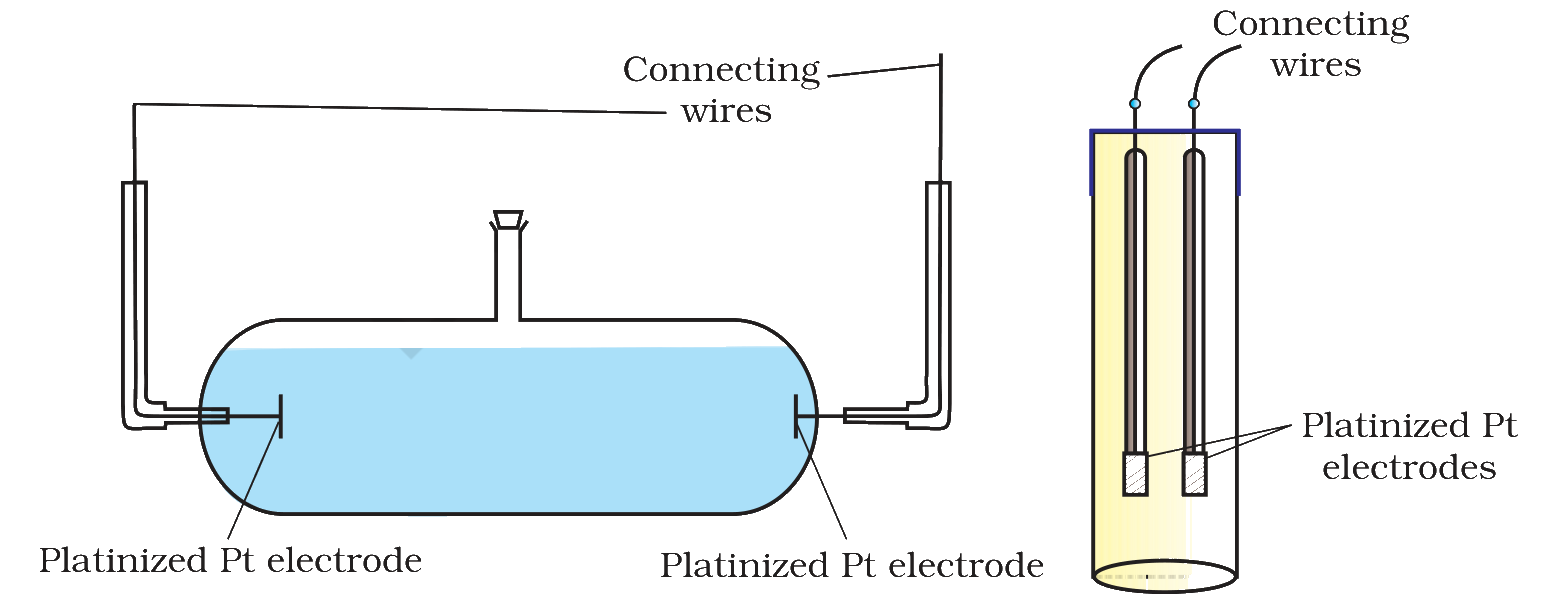
Two vessels fitted with electrodes

What is this vessel used for?

Answer & explanation+

Correct answer: option 4

The correct answer is Option (4) → To measure the resistance, and so the conductivity, of the solution

Each design in the figure has two identical platinized Pt electrodes (platinum coated with platinum black) dipping in the same solution and joined to connecting wires, with no salt bridge and no gas supply. This vessel is a conductivity cell. The solution between the electrodes (area of cross section A, distance l apart) forms a column whose resistance is measured, and the conductivity of the solution is found from it:

    \( R = \rho\,\frac{l}{A} = \frac{l}{\kappa A} \)

Why the other options are incorrect

Option (1) To get an emf from the two electrodes acting as anode and cathode — Incorrect. Both electrodes are the same platinized Pt in the same solution, so they do not form two different half-cells and give no cell emf.

Option (2) To serve as a standard hydrogen electrode for measuring electrode potentials — Incorrect. The standard hydrogen electrode has pure hydrogen gas at 1 bar bubbled over a platinum electrode in a 1 M H+ solution; the vessels shown have two electrodes and no hydrogen supply.

Option (3) To produce electricity from hydrogen and oxygen fed to the electrodes — Incorrect. In the H2–O2 fuel cell the gases are bubbled through porous carbon electrodes into concentrated NaOH; the vessels shown have no gas inlets at the electrodes.

NCERT (2026-27 edition):
2.4.1 Measurement of the Conductivity of Ionic Solutions – “…for measuring the resistance of an ionic solution we face two problems. …Secondly, a solution cannot be connected to the bridge like a metallic wire or other solid conductor. …The second problem is solved by using a specially designed vessel called conductivity cell. It is available in several designs and two simple ones are shown in Fig. 2.4.”

“Basically it consists of two platinum electrodes coated with platinum black (finely divided metallic Pt is deposited on the electrodes electrochemically). These have area of cross section equal to ‘A’ and are separated by distance ‘l’. Therefore, solution confined between these electrodes is a column of length l and area of cross section A. The resistance of such a column of solution is then given by the equation:”

    \( R = \rho\,\frac{l}{A} = \frac{l}{\kappa A} \qquad (2.17) \)

Fig. 2.4

Fig. 2.4: Two different types of conductivity cells.

Advertisement

Practise more on Physical: Electro Chemistry

Chapter-wise mocks on the real NTA exam screen, with solutions and your rank. Your first mocks are free.

Start free mocks →

Advertisement

Next questions

  1. If X is a Poisson variable such that P(X=1)=2P(X=2) , then P(X=3) is :Applied Maths. Section B2 · Probability Distributions
  2. A thief is spotted by a policeman from a distance of 480 m. When the policeman starts the chase, the thief also starts running. If the spee…General Aptitude Test · Numerical Ability
  3. Select the INCORRECTLY spelt word.English · Spelling Check
  4. Identify the Venn diagram that best represents the relationship between the given classes. Bottle, Cat, BookGeneral Aptitude Test · Verbal Reasoning
  5. In Sternberg's triarchic theory, which component of componential intelligence involves planning concerning what to do and how to do it?Psychology · Variations in Psychological Attributes
  6. Which of the following factors leads to the conversion of the Bt toxin present in Bt cotton plant tissue into an active toxin? Choose the c…Biology · Biotechnology and its Applications
  7. X men can finish a piece of work in 30 days. If there were 6 men more, the work could be finished in 10 days less. The original number of m…General Aptitude Test · Numerical Ability
  8. As per Schedule III of the Companies Act 2013, Balance sheet of companies is now prepared in :Accountancy Part B · Financial Statements of a Company
  9. Interest paid on loan taken from IMF will be recorded in ________ side of ________ account.Economics · Macro Economics: Open Economy Macro Economics
  10. At 5 p.m. on a sunny day, Aarav stands on a straight road and notices that his shadow falls exactly behind him. Which direction is he facin…General Aptitude Test · Verbal Reasoning