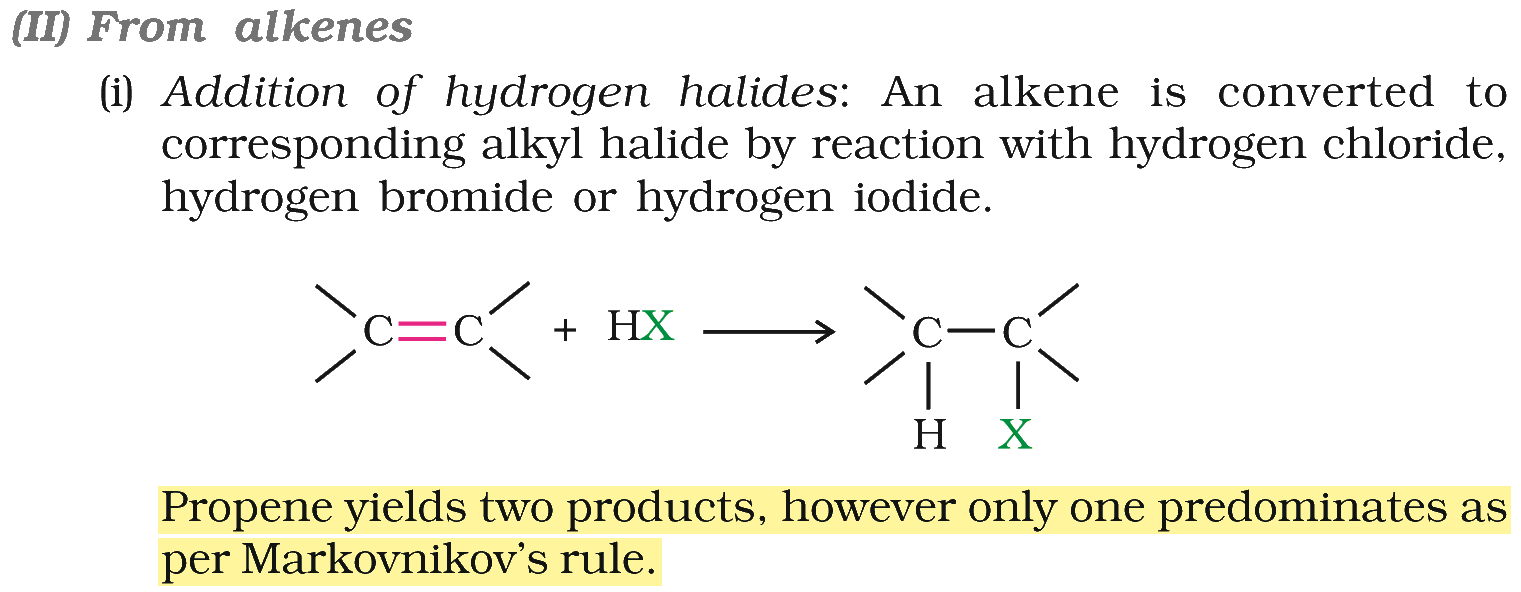
What would be the major product in the following reaction, and which rule would explain the formation of the major product?
CH3CH=CH2 + HI → CH3CH2CH2I (a) + CH3CHICH3 (b)
Answer & explanation
Correct answer: option 2
The correct answer is Option (2) → (b) and Markovnikov's rule
Markovnikov’s rule predicts the major product when an unsymmetrical reagent HX adds to an unsymmetrical alkene: the negative part (X) goes to the carbon atom of the double bond that carries fewer hydrogen atoms. The reason is the mechanism. \( \ce{H^{+}} \) adds first to give a carbocation, and the more stable carbocation is formed:
\( \displaystyle \ce{CH3-CH=CH2 + H^+ -> CH3-CH^+-CH3}\quad\text{(2}^\circ\text{, more stable)} \)
The halide ion then attacks the secondary carbocation, so the halogen ends up on the middle carbon:
\( \displaystyle \ce{CH3-CH=CH2 + HX -> CH3-CHX-CH3} \)
So the major product is (b) CH3CHICH3 (2-iodopropane), and it is explained by Markovnikov’s rule.
Why the other options are incorrect
Option (1) (a) and Antimarkovnikov's rule — Incorrect. The anti-Markovnikov product (a) forms only with HBr in the presence of a peroxide (peroxide or Kharasch effect), which works by a free radical path; it does not apply to HI.
Option (3) (b) and Antimarkovnikov's rule — Incorrect. (b) is the correct product, but it is the Markovnikov product, not the anti-Markovnikov one.
Option (4) (a) and Markovnikov's rule — Incorrect. In (a) iodine is on the \( \ce{CH2} \) carbon, which already has more hydrogens, so (a) is not the Markovnikov product.
NCERT (2026-27 edition):
From Alkenes