
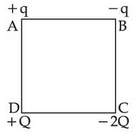
Four charges q, −q, −2Q and Q are placed at the corners of a square ABCD of side ‘2a’ as shown. The field at the midpoint CD is zero. Find the ratio of \( \displaystyle\frac{q}{Q} \).
Answer & explanation
Correct answer: option 3
The correct answer is Option (3) → \( \displaystyle-\frac{15\sqrt{5}}{2} \)
The field at the midpoint M of CD is the vector sum of the fields of the four charges (superposition). Take M as the origin with CD along the x-axis: D and C are at distance a from M, and A and B are at distance \( \sqrt{a^{2} + (2a)^{2}} = a\sqrt{5} \) from M. For the net field to vanish, the contribution of the pair q, −q must balance that of the pair Q, 2Q along CD, and the components perpendicular to CD must cancel.
Charges at C and D (both fields along CD, at distance a)
\( \displaystyle E_{CD} = \frac{kQ}{a^{2}} + \frac{k\,2Q}{a^{2}} = \frac{3kQ}{a^{2}} \)
Charges at A and B (each of magnitude \( \frac{kq}{5a^{2}} \), at distance \( a\sqrt{5} \))
The components perpendicular to CD cancel, and each charge gives the component along CD with \( \cos\theta = \frac{a}{a\sqrt{5}} = \frac{1}{\sqrt{5}} \) (the line from M to A or B makes this angle with CD, so each component is smaller by the factor \( 1/\sqrt{5} \)):
\( \displaystyle E_{AB} = 2\times\frac{kq}{5a^{2}}\times\frac{1}{\sqrt{5}} = \frac{2kq}{5\sqrt{5}\,a^{2}} \)
Balance of the two contributions (the two must be opposite, so q is negative)
\( \displaystyle \frac{2q}{5\sqrt{5}} = -3Q \)
\( \displaystyle \frac{q}{Q} = -\frac{15\sqrt{5}}{2} \)