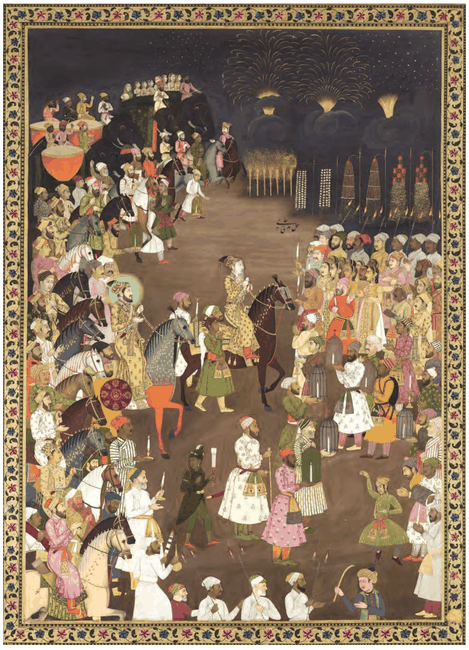
The Marriage Procession of Dara Shikoh is a painting of the Mughal School. Consider the following statements about it:
(A) Dara Shikoh was the eldest son of the Mughal emperor Shah Jahan.
(B) The prince is shown wearing the traditional sehra.
(C) The prince is accompanied by his brother, who rides a white horse.
(D) The artist has created the glamour of the procession with all its pomp and show.
Choose the correct answer from the options given below:
Answer & explanation
Correct answer: option 3
The correct answer is Option (3) → (A), (B) and (D) only
(A) Dara Shikoh was the eldest son of the Mughal emperor Shah Jahan. — Correct. The painting shows the marriage of Dara Shikoh, the eldest son of Shah Jahan.
(B) The prince is shown wearing the traditional sehra. — Correct. He rides a brown stallion with the traditional sehra.
(C) The prince is accompanied by his brother, who rides a white horse. — Incorrect. The rider of the white horse is his father, Shah Jahan, not a brother.
(D) The artist has created the glamour of the procession with all its pomp and show. — Correct. The artist brings out the glamour and pomp and show of the wedding march.
NCERT (2026-27): “The Marriage Procession of Dara Shikoh This painting, a work by artist Haji Madni, belongs to the period of Shah Jahan, who built the Taj Mahal in Agra. It is a portrayal of the marriage procession of Dara Shikoh, the eldest son of Mughal emperor Shah Jahan. The Mughal prince is shown mounted on a brown stallion with the traditional sehra and is accompanied by his father, Shah Jahan, who has a resplendent nimbus around hid head, riding a white horse. The marriage procession is accompanied and received by music, dance, gifts and fireworks. The artist has created the glamour of the marriage procession with all its pomp and show.…”
|