Average propensity to save (APS) is measured by :
Answer & explanation
Correct answer: option 3
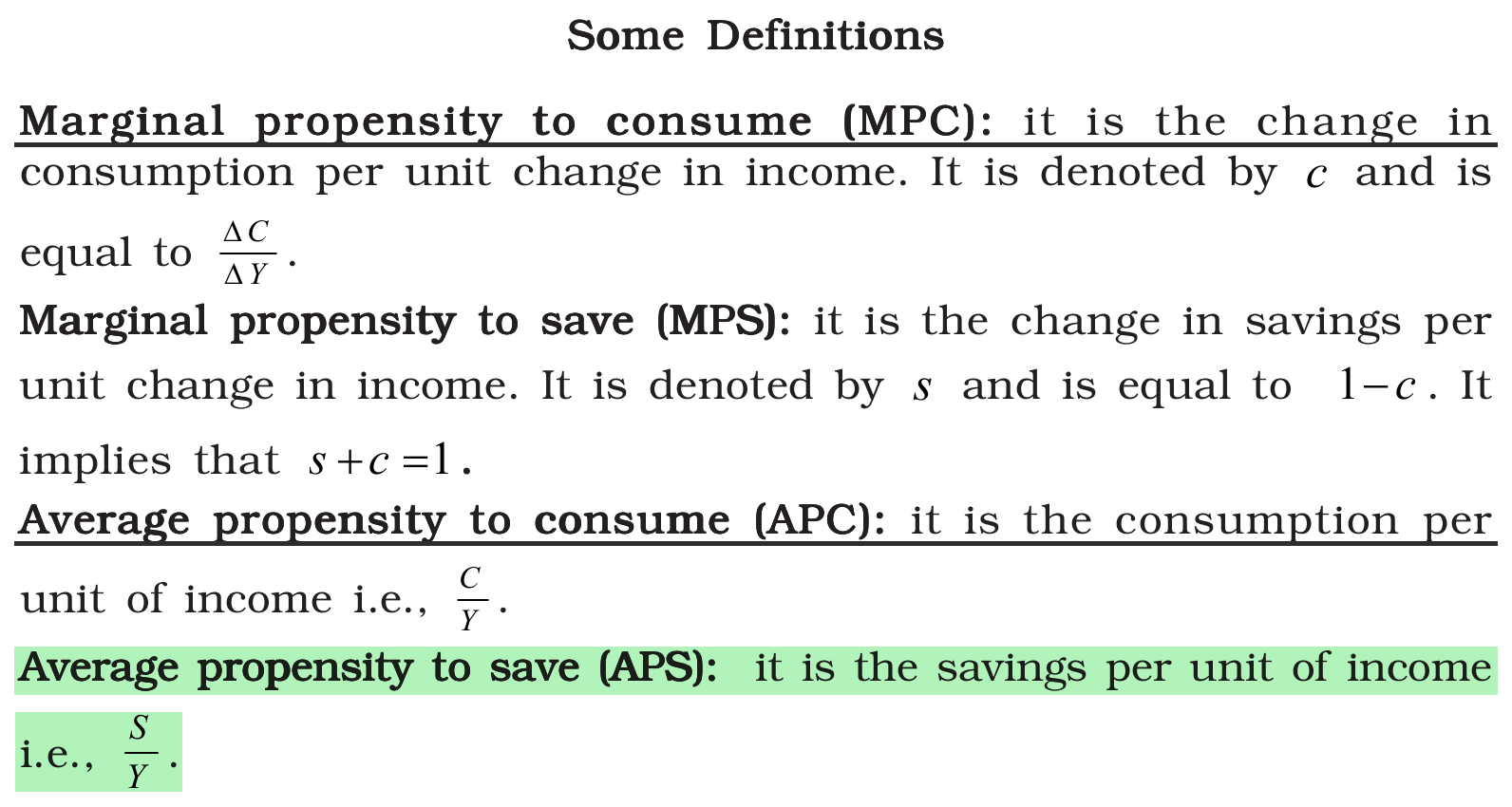
The correct answer is Option (3) → \( \displaystyle APS=\frac{S}{Y} \)
The average propensity to save (APS) is savings per unit of income. Here S is savings, C is consumption and Y is income.
Option (1) \( \displaystyle APS=\frac{\Delta C}{\Delta Y} \) — Incorrect. This ratio is the marginal propensity to consume, the change in consumption per unit change in income.
Option (2) APS = 1 - C — Incorrect. C is an amount of consumption, not a ratio. Income is consumed or saved, so the right form is APS = 1 minus APC. APC is the average propensity to consume.
Option (3) \( \displaystyle APS=\frac{S}{Y} \) — Correct. It divides total savings by total income.
Option (4) \( \displaystyle APS=\frac{C}{Y} \) — Incorrect. This ratio is the average propensity to consume, which is consumption per unit of income.
NCERT (2026-27): Introductory Macroeconomics — Chapter 4: Determination of Income and Employment, Some Definitions
|