
Which of the following statements is correct?
Answer & explanation
Correct answer: option 4
The correct answer is Option (4) → All of these.
The sex chromosomes differ between groups of animals. In the grasshopper (XO type) the female has a pair of X chromosomes and the male only one X. In humans and in Drosophila (XY type) the female is XX and the male is XY. A human with one extra X chromosome (XXY) has Klinefelter’s syndrome.
Option (1) XX chromosomes are present in grasshopper female. — Correct statement, but it is only one of the correct points, so on its own it is not the answer. The female grasshopper has a pair of X chromosomes besides the autosomes; only the male lacks the second X.
Option (2) XXY chromosomes are present in humans with Klinefelter’s syndrome. — Correct statement, but it is only one of the correct points, so on its own it is not the answer. Klinefelter’s syndrome is caused by an additional copy of the X chromosome, giving the karyotype 47, XXY.
Option (3) XY chromosomes are present in male Drosophila. — Correct statement, but it is only one of the correct points, so on its own it is not the answer. In Drosophila, as in humans, the male has one X and one Y chromosome.
All three statements are correct, so the answer is “All of these”.
NCERT Extract:
Sex Determination – “… Grasshopper is an example of XO type of sex determination in which the males have only one X-chromosome besides the autosomes, whereas females have a pair of X-chromosomes.”
Sex Determination – “… In human beings and in Drosophila the males have one X and one Y chromosome, whereas females have a pair of X-chromosomes besides autosomes (Figure 4.12 a, b).”
Chromosomal Disorders – “… Klinefelter’s Syndrome : This genetic disorder is also caused due to the presence of an additional copy of X-chromosome resulting into a karyotype of 47, XXY.”
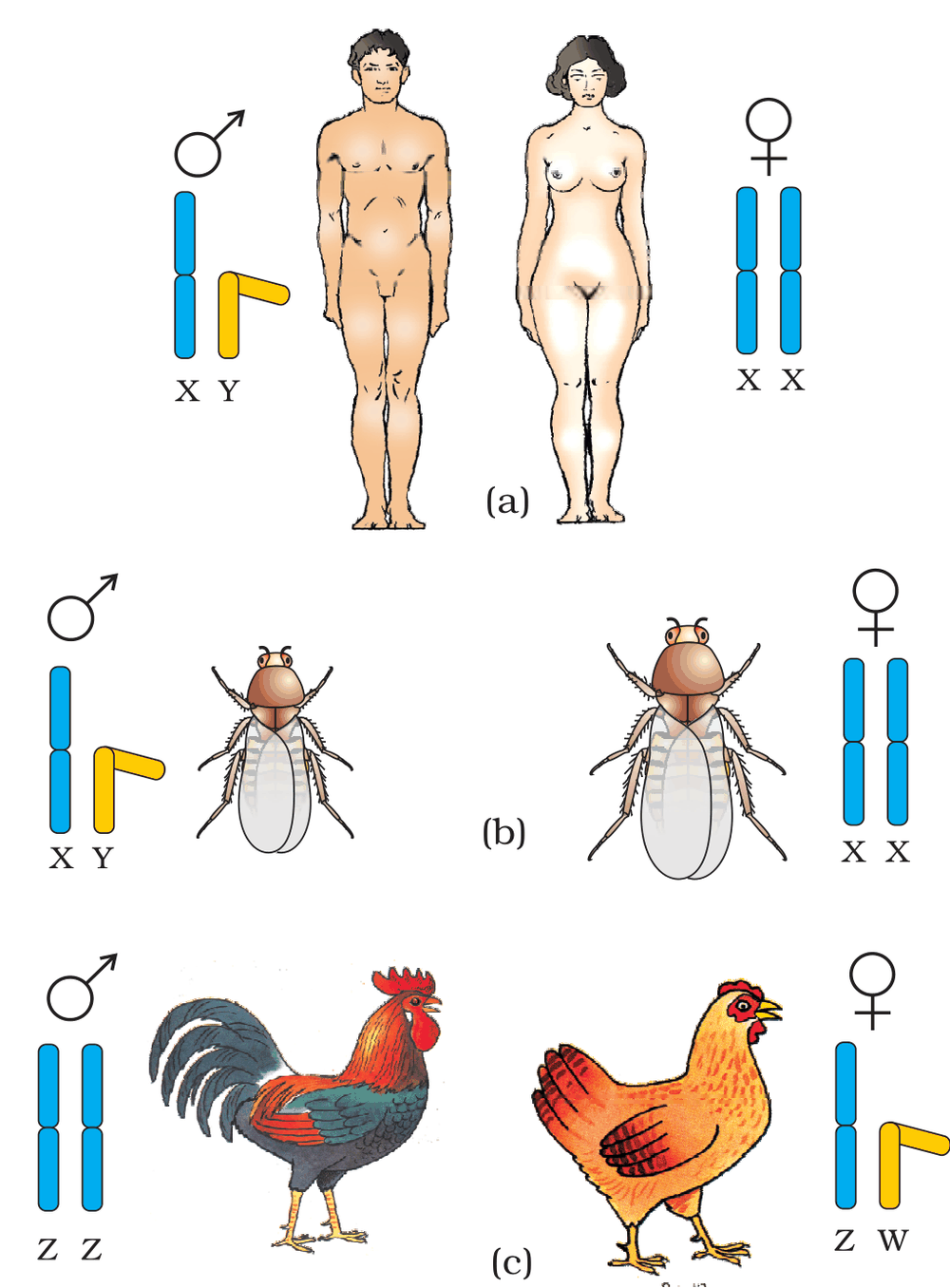
Figure 4.12 Determination of sex by chromosomal differences: (a,b) Both in humans and in Drosophila, the female has a pair of XX chromosomes (homogametic) and the male XY (heterogametic) composition; (c) In many birds, female has a pair of dissimilar chromosomes ZW and male two similar ZZ chromosomes