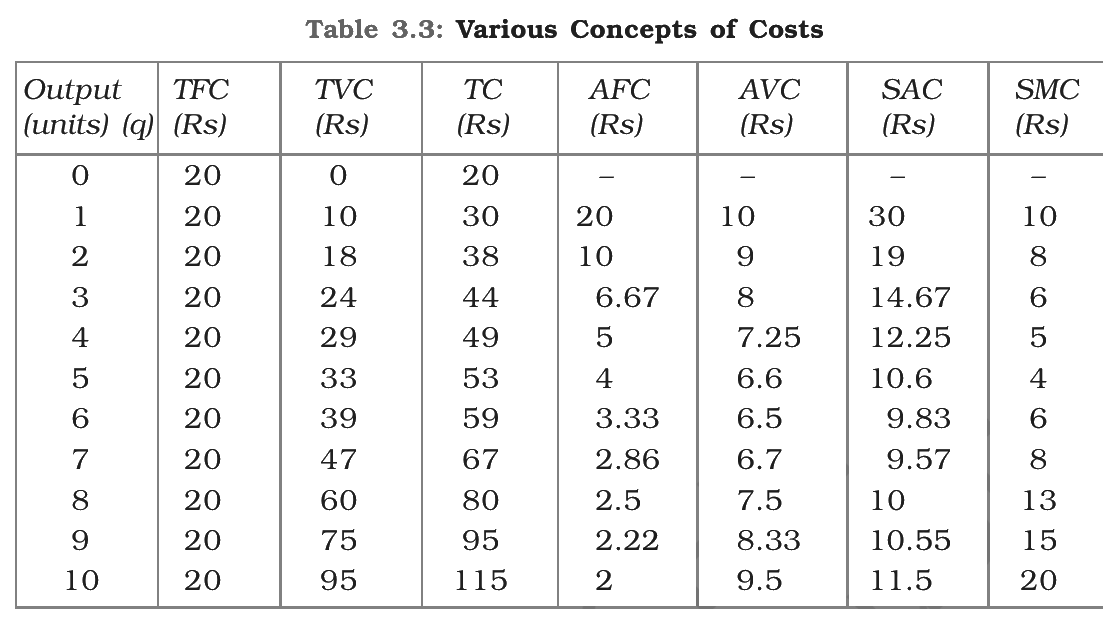
The total cost (TC) of a firm at some levels of output is given below:
| Output (units) | 5 | 6 | 7 | 8 | 9 |
|---|---|---|---|---|---|
| TC (Rs) | 53 | 59 | 67 | 80 | 95 |
Among these levels, at which output is the short run average cost (SAC) the lowest?
Answer & explanation
Correct answer: option 3
The correct answer is Option (3) → 7 units
SAC is total cost per unit of output, so divide each TC by its output.
\( \displaystyle 5 \text{ units: } \frac{53}{5} = 10.6 \)
\( \displaystyle 6 \text{ units: } \frac{59}{6} = 9.83 \)
\( \displaystyle 7 \text{ units: } \frac{67}{7} = 9.57 \)
\( \displaystyle 8 \text{ units: } \frac{80}{8} = 10 \)
\( \displaystyle 9 \text{ units: } \frac{95}{9} = 10.56 \)
SAC falls till 7 units and rises after it, so the lowest SAC is at 7 units.
NCERT (2026-27): “3.7.1 Short Run Costs … The short run average cost (SAC) incurred by the firm is defined as the total cost per unit of output. We calculate it as SAC = TC/q (3.7) In Table 3.3, we get the SAC-column by dividing the values of the fourth column by the corresponding values of the first column. At zero output, SAC is undefined. For the first unit, SAC is Rs 30; for 2 units of output, SAC is Rs 19 and so on.”
|