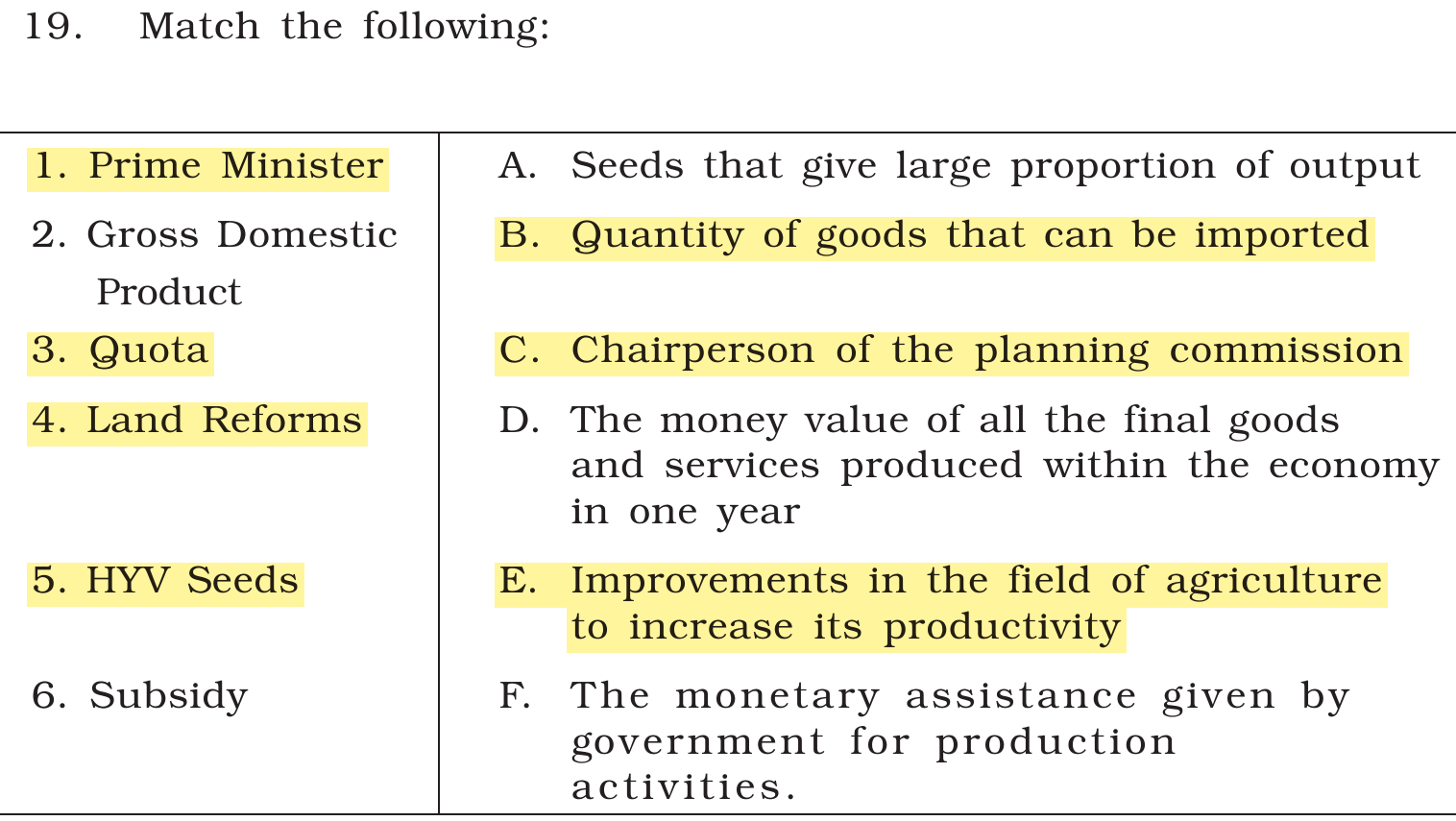
Match List-I with List-II.
| List-I | List-II |
| (A) Prime Minister | (I) Quantity of goods that can be imported |
| (B) Quota | (II) Increase production of food grains |
| (C) Land Reforms | (III) Chairperson of the Planning Commission |
| (D) HYV Seeds | (IV) Improvements in the field of agriculture to increase its productivity |
Choose the correct answer from the options given below :
Answer & explanation
Correct answer: option 2
The correct answer is Option (2) → (A)-(III), (B)-(I), (C)-(IV), (D)-(II)
The items come from India’s planning period, 1950-1990: planning, trade policy and farming.
| List-I | List-II | Reason |
|---|---|---|
| (A) Prime Minister | (III) Chairperson of the Planning Commission | The Planning Commission was set up in 1950 with the Prime Minister as its Chairperson. |
| (B) Quota | (I) Quantity of goods that can be imported | A quota fixes the quantity of a good that may be imported, to protect home industry. |
| (C) Land Reforms | (IV) Improvements in the field of agriculture to increase its productivity | Land reforms, such as giving land to the tiller, changed land ownership so that farmers would invest and produce more. |
| (D) HYV Seeds | (II) Increase production of food grains | High yielding variety seeds give a much larger output; they brought the Green Revolution in food grains. |
Note: This question is taken from a match-the-following exercise at the end of the chapter ‘Indian Economy 1950-1990’ of NCERT. The book’s exercise has six items; the paper keeps four of them and describes HYV seeds in its own words.
NCERT (2026-27): Indian Economic Development — Chapter 2: Indian Economy 1950-1990
NCERT (2026-27): “…In 1950, the Planning Commission was set up with the Prime Minister as its Chairperson. The era of five year plans had begun.… …The low productivity of the agricultural sector forced India to import food from the United States of America (U.S.A.). Equity in agriculture called for land reforms which primarily refer to change in the ownership of landholdings.… …The stagnation in agriculture during the colonial rule was permanently broken by the green revolution. This refers to the large increase in production of food grains resulting from the use of high yielding variety (HYV) seeds especially for wheat and rice.… …Quotas specify the quantity of goods which can be imported. The effect of tariffs and quotas is that they restrict imports and, therefore, protect the domestic firms from foreign competition.…” |