CUETMOCK
  • Pricing
  • Mentors
Log inStart freeStart free mocks→

First test, then trust

Try a free CUET mock test.

Join 5,00,000+ students who rehearsed exam day on the exact NTA screen before sitting CUET. On the web and on Android.

Start free mocks →Get the Android app
CUETMOCK

India's #1 CUET Mock Test Platform. Original NCERT-based questions on the exact NTA exam screen — trusted by 5,00,000+ students since CUET 2022.

Get it onGoogle PlayScan to download the CUETMOCK app

Mock tests

  • CUET mock test series
  • Browse all papers
  • Commerce mocks
  • Humanities (Arts) mocks
  • Science mocks
  • Languages & GAT mocks
  • Free practice questions
  • Pricing

Resources

  • CUET exam guide
  • CUET syllabus
  • Universities accepting CUET
  • Expert blogs
  • News & notifications
  • Webinars & counselling
  • CUET score calculator
  • How we estimate your rank
  • FAQs

Company

  • About us
  • Our leadership & team
  • Our toppers
  • Mentors
  • For schools
  • Contact us
  • Terms
  • Privacy
  • Refund policy

Talk to us

+91 7696 6630 56info@cuetmock.comWhatsApp us

Our other platforms

  • JEE Mock — For IIT-JEE aspirants
  • NEET Mock — For NEET aspirants

Newsletter

Exam updates, study material and offers — no spam.

© 2026 NYC Ventures Pvt. Ltd.

701-702, Royal Business Park, Zirakpur, Punjab - 140603

  • Terms of use
  • Privacy policy
  • Refund policy
  • Contact us

iCUETMOCK is an independent preparation platform, not affiliated with the National Testing Agency (NTA). Always check exam details on the official NTA website.

  • Home
  • Mock tests
  • CUET guide
  • Pricing
  • Log in
Home/Practice questions/History
HistoryMedieval India: Peasants, Zamindars and the State

In Mansabdari System, some mansabdars were paid in cash, while the ma…

In Mansabdari System, some mansabdars were paid in cash, while the majority of them were paid through assignments of revenue in different regions of the Mughal Empire. What was 'cash' and 'assignment of revenue' called in Mansabdari System?

Answer & explanation+

Correct answer: option 3

The correct answer is Option (3) → Naqdi and Jagir

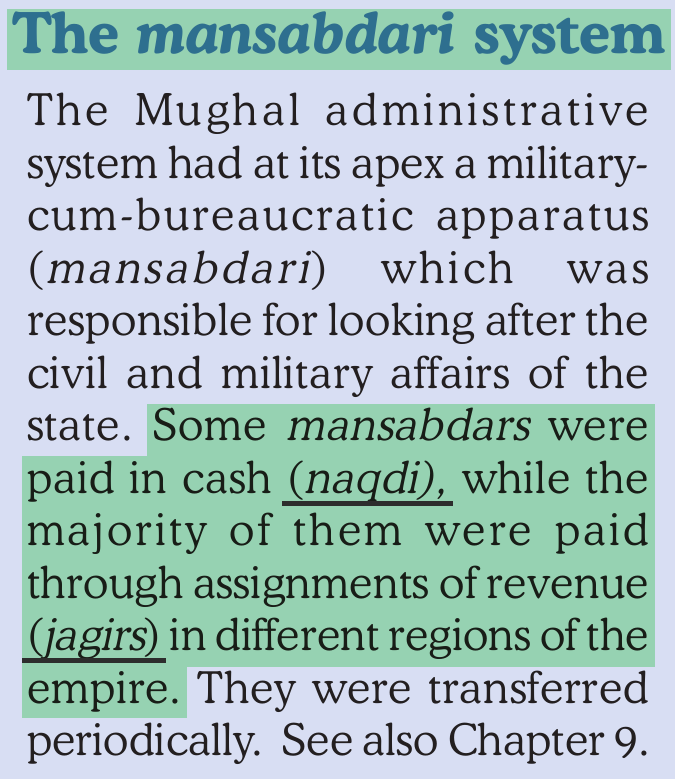
Some mansabdars were paid in cash, called naqdi, while the majority of them were paid through assignments of revenue, called jagirs, in different regions of the empire.


NCERT: Themes in Indian History Part II — Chapter 8: Peasants, Zamindars and the State (2026-27)

NCERT extract

Advertisement

Practise more on Medieval India: Peasants, Zamindars and the State

Chapter-wise mocks on the real NTA exam screen, with solutions and your rank. Your first mocks are free.

Start free mocks →

Advertisement

Next questions

  1. Arrange the establishment of the European Companies in a chronological order.A. French in PondicherryB. British in BombayC. Dutch in Masuli…History · Modern India: Colonial cities
  2. Match List-I with List-II.List-IList-II(A) Setting performance standards(I) Sample checking of pieces at random in large organisations(B) M…Business Studies · Controlling
  3. When the price of a good falls from Rs 12 per unit to Rs 9 per unit, the producer supplies 75% less output. Calculate the price elasticity…Economics · Micro Economics: Theory of Firms under Perfect Competition
  4. Rs 6000 is the expenditure done onGeneral Aptitude Test · Quantitative Reasoning
  5. If cot43θ + tan43θ = 2, find 2sin2θ + cos4θ.General Aptitude Test · Quantitative Reasoning
  6. उपर्युक्त काव्यांश में कब की घटना का वर्णन है?Hindi · Comprehension - (Poetry / Literary)
  7. Which of the following country is completely land locked country surrounded by which country from all sides?General Aptitude Test · General Knowledge
  8. A charge 1.2×10^-8 C is uniformly distributed on the conducting sphere of radius 5 cm. The magnitude of the electric field at the centre of…Physics · Electric Charges and Fields
  9. Statement I: Under the Right to be assured, a consumer has the freedom to access a variety of products at competitive prices.Statement II:…Business Studies · Consumer Protection
  10. Where is the artwork currently housed?Fine Arts · The Rajasthani Schools of Painting