Match the LIST-I with LIST-II:
| LIST-I Land Characteristics | LIST-II Term | ||
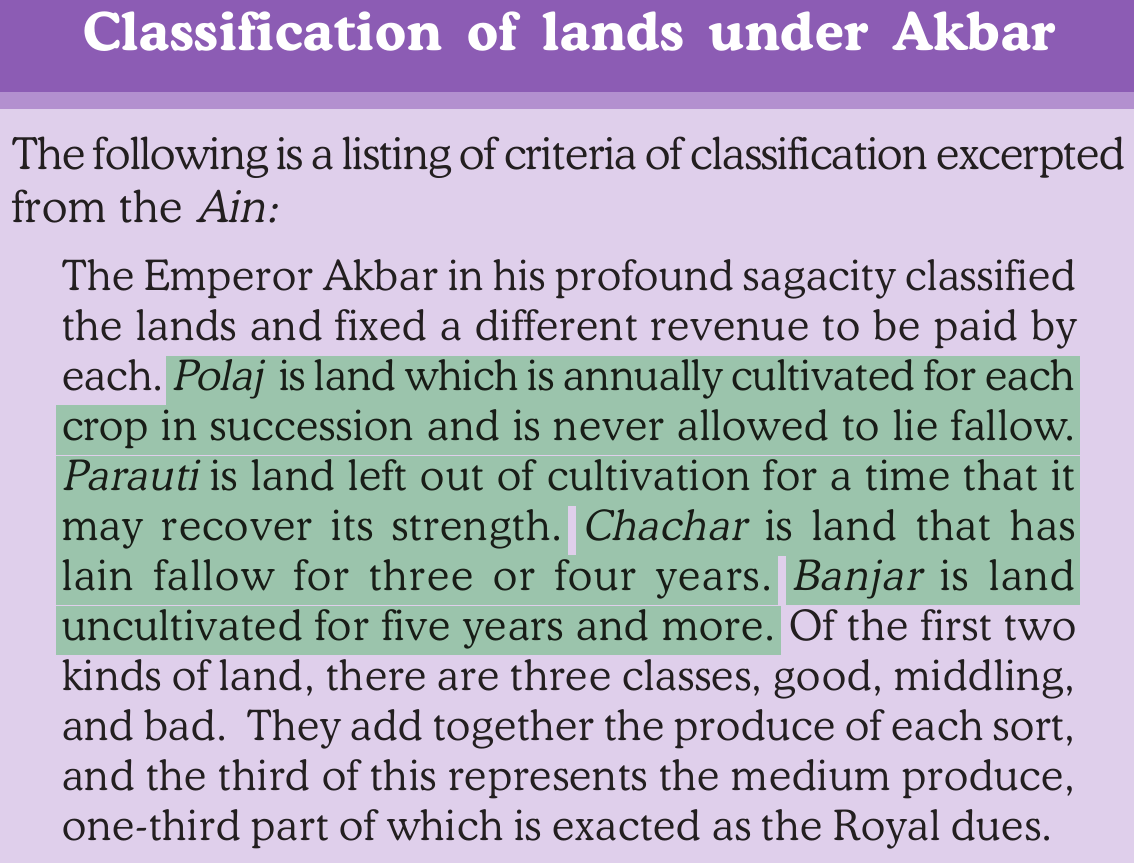
| A. | Land left out of cultivation for a time so that it may recover its strength | I. | Polaj |
| B. | Land annually cultivated and is never allowed to lie fallow | II. | Chachar |
| C. | Land that has lain fallow for three or four years | III. | Parauti |
| D. | Land uncultivated for five years and more | IV. | Banjar |
Choose the correct answer from the options given below:
Answer & explanation
Correct answer: option 2
The correct answer is Option (2) → A - III, B - I, C - II, D - IV
(A) Land left out of cultivation for a time so that it may recover its strength — this matches (III) Parauti. Parauti is land rested for a short time.
(B) Land annually cultivated and is never allowed to lie fallow — this matches (I) Polaj. Polaj is land cultivated every year, for each crop in succession.
(C) Land that has lain fallow for three or four years — this matches (II) Chachar. Chachar is land that has lain fallow for three or four years.
(D) Land uncultivated for five years and more — this matches (IV) Banjar. Banjar is land left uncultivated for five years and more, the longest of the four.
Tip: Akbar classified the lands and fixed a different revenue for each class. The four classes go in order of how long the land lies fallow: polaj never, parauti for a short time, chachar three or four years, banjar five years and more.
Note: A same/similar question was asked in CUET (UG) in the papers below.
| 2026 | 2025 | 2024 | 2023 | 2022 |
| 13-05 S1* 21-05 S1* 29-05 S2 | 16-05 S1* | – | 30-05 S2* 06-06 S1* 23-06 S3* | – |
* A similar question.
NCERT: Themes in Indian History Part II — Chapter 8: Peasants, Zamindars and the State (2025-26)
|