An organic compound on oxidation with KMnO4 gives carboxylic acid but produces an aldehyde with PCC. The compound used in the reaction is a/an
Answer & explanation
Correct answer: option 1
The correct answer is Option (1) → Primary alcohol.
What an alcohol gives on oxidation depends on its class and on the strength of the oxidising agent:
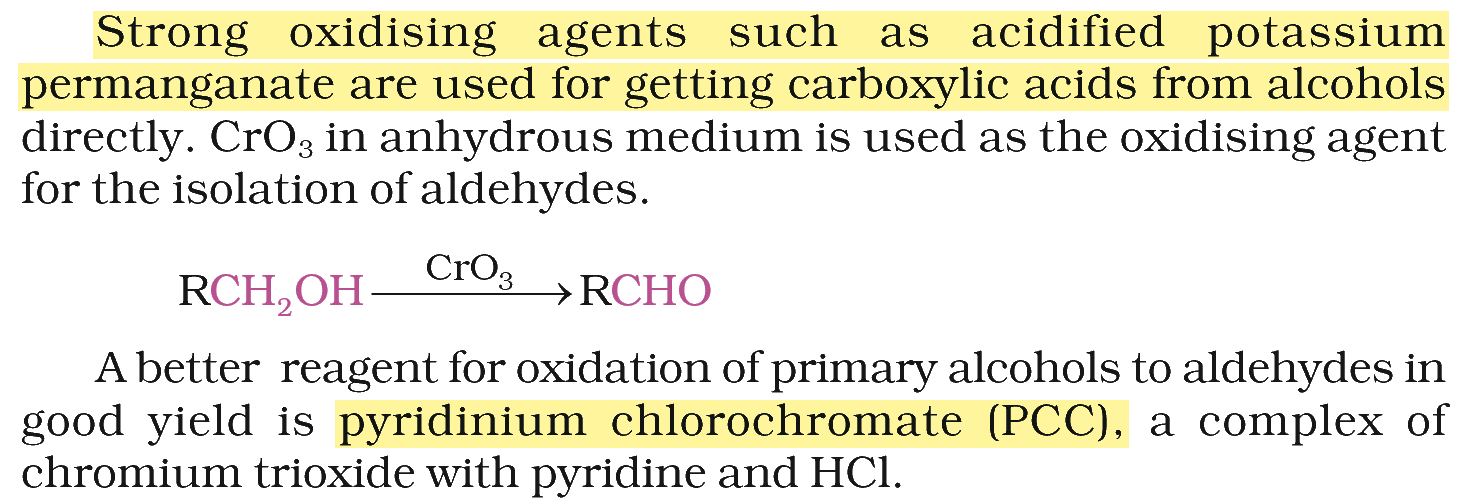
Primary alcohols are oxidised first to aldehydes and then to carboxylic acids. A strong oxidising agent such as KMnO4 takes them all the way to the carboxylic acid. PCC (pyridinium chlorochromate, a complex of \( \ce{CrO3} \) with pyridine and HCl) is a mild reagent that stops at the aldehyde.
Secondary alcohols are oxidised to ketones.
Tertiary alcohols are not oxidised under normal conditions.
\( \displaystyle \ce{RCH2OH} \xrightarrow{\ce{KMnO4}} \ce{RCOOH} \)
\( \displaystyle \ce{RCH2OH} \xrightarrow{\text{PCC}} \ce{RCHO} \)
The compound gives a carboxylic acid with \( \ce{KMnO4} \) and an aldehyde with PCC, so it is a primary alcohol.
Why the other options are incorrect
Option (2) Aldehyde. — Incorrect. An aldehyde is already the product of PCC oxidation; PCC leaves it unchanged, so it cannot be the compound that gives an aldehyde with PCC.
\( \displaystyle \ce{RCHO} \xrightarrow{\ce{KMnO4}} \ce{RCOOH} \)
Option (3) ketone. — Incorrect. Ketones resist mild oxidation. Strong oxidising agents at high temperature break C–C bonds and give a mixture of acids with fewer carbon atoms, never an aldehyde with PCC.
Option (4) Secondary alcohol — Incorrect. It gives a ketone with both reagents, not a carboxylic acid or an aldehyde.
\( \displaystyle \ce{R2CH-OH} \xrightarrow{\text{PCC}} \ce{R2C=O} \)
NCERT (2026-27 edition):
Oxidation – …