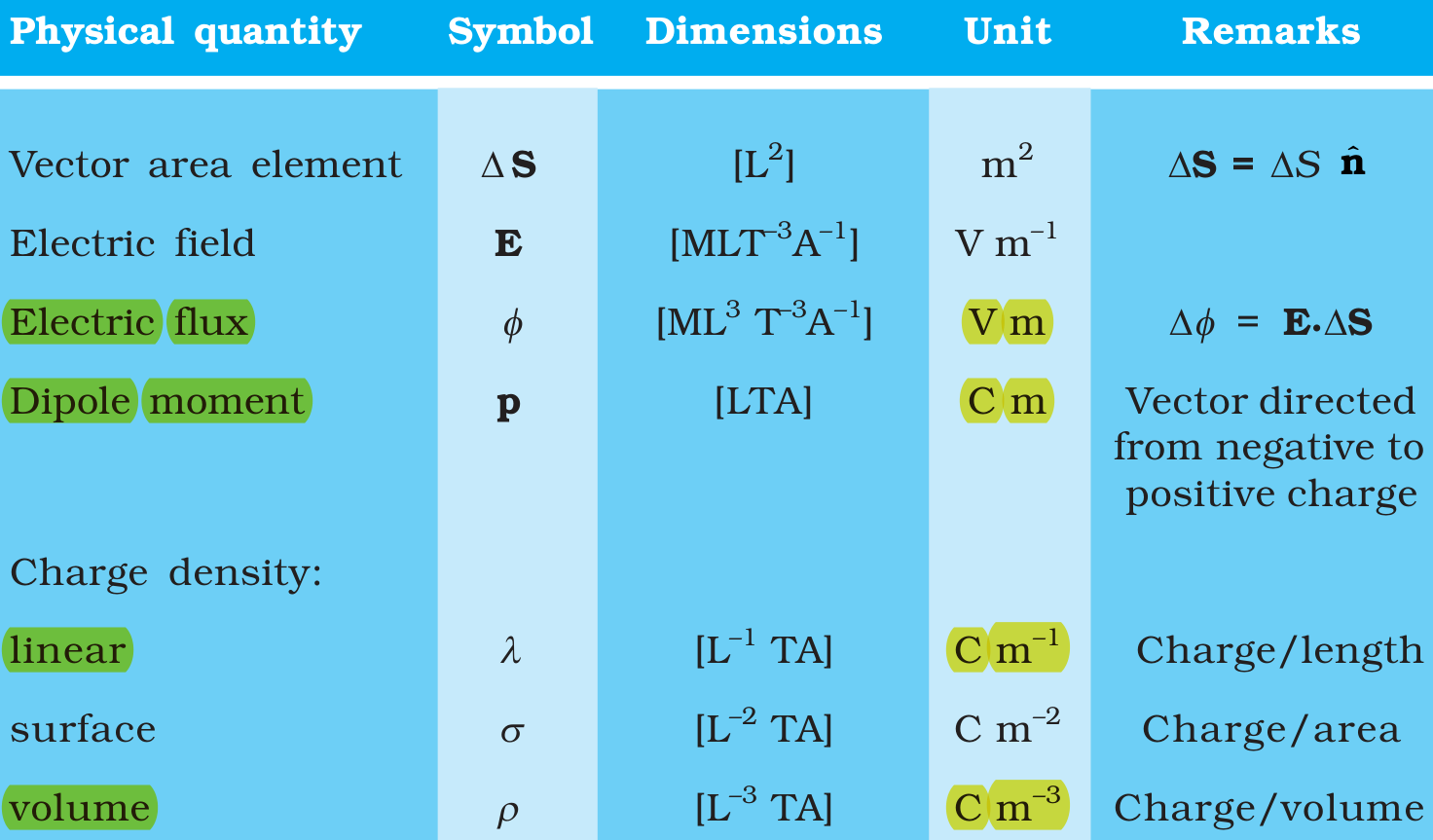
Match List - I with List - II.
| List – I | List – II | ||
|---|---|---|---|
| (A) | Electric dipole moment | (I) | \( \mathrm{N\,m^{2}\,C^{-1}} \) |
| (B) | Linear charge density | (II) | \( \mathrm{C\,m^{-3}} \) |
| (C) | Volume charge density | (III) | \( \mathrm{C\,m} \) |
| (D) | Electric flux | (IV) | \( \mathrm{A\,m^{-1}\,s} \) |
Choose the correct answer from the options given below:
Answer & explanation
Correct answer: option 2
The correct answer is Option (2) → (A)-(III), (B)-(IV), (C)-(II), (D)-(I)
Each unit follows from the definition of the quantity.
(A) Electric dipole moment — this matches (III) \( \mathrm{C\,m} \). The dipole moment is charge times separation, \( p = q\times2a \).
(B) Linear charge density — this matches (IV) \( \mathrm{A\,m^{-1}\,s} \). It is charge per unit length, \( \mathrm{C\,m^{-1}} \), and since \( \mathrm{C} = \mathrm{A\,s} \), this is \( \mathrm{A\,s\,m^{-1}} \).
(C) Volume charge density — this matches (II) \( \mathrm{C\,m^{-3}} \). It is charge per unit volume.
(D) Electric flux — this matches (I) \( \mathrm{N\,m^{2}\,C^{-1}} \). The flux is field times area, \( \Phi = EA \), and E is in \( \mathrm{N\,C^{-1}} \).
NCERT (2026-27):
Summary – …