
CUETMOCK
  • Pricing
  • Mentors
Log inStart freeStart free mocks→

First test, then trust

Try a free CUET mock test.

Join 5,00,000+ students who rehearsed exam day on the exact NTA screen before sitting CUET. On the web and on Android.

Start free mocks →Get the Android app
CUETMOCK

India's #1 CUET Mock Test Platform. Original NCERT-based questions on the exact NTA exam screen — trusted by 5,00,000+ students since CUET 2022.

Get it onGoogle PlayScan to download the CUETMOCK app

Mock tests

  • CUET mock test series
  • Browse all papers
  • Commerce mocks
  • Humanities (Arts) mocks
  • Science mocks
  • Languages & GAT mocks
  • Free practice questions
  • Pricing

Resources

  • CUET exam guide
  • CUET syllabus
  • Universities accepting CUET
  • Expert blogs
  • News & notifications
  • Webinars & counselling
  • CUET score calculator
  • How we estimate your rank
  • FAQs

Company

  • About us
  • Our leadership & team
  • Our toppers
  • Mentors
  • For schools
  • Contact us
  • Terms
  • Privacy
  • Refund policy

Talk to us

+91 7696 6630 56info@cuetmock.comWhatsApp us

Our other platforms

  • JEE Mock — For IIT-JEE aspirants
  • NEET Mock — For NEET aspirants

Newsletter

Exam updates, study material and offers — no spam.

© 2026 NYC Ventures Pvt. Ltd.

701-702, Royal Business Park, Zirakpur, Punjab - 140603

  • Terms of use
  • Privacy policy
  • Refund policy
  • Contact us

iCUETMOCK is an independent preparation platform, not affiliated with the National Testing Agency (NTA). Always check exam details on the official NTA website.

  • Home
  • Mock tests
  • CUET guide
  • Pricing
  • Log in
Home/Practice questions/Biology
BiologySexual Reproduction in Flowering Plants

A typical angiosperm anther is generally:

A typical angiosperm anther is generally:

Answer & explanation+

Correct answer: option 2

The correct answer is Option (2) → Bilobed

Each theca holds two microsporangia, so the anther is tetrasporangiate.

Option (2) Bilobed — Correct. A typical angiosperm anther is bilobed, each lobe having two thecae, so it is dithecous. In transverse section it is a tetragonal structure with four microsporangia, two in each lobe.

NCERT Extract:
Stamen, Microsporangium and Pollen Grain – “… A typical angiosperm anther is bilobed with each lobe having two theca, i.e., they are dithecous …. Often a longitudinal groove runs lengthwise separating the theca. Let us understand the various types of tissues and their organisation in the transverse section of an anther (Figure 1.3a).”
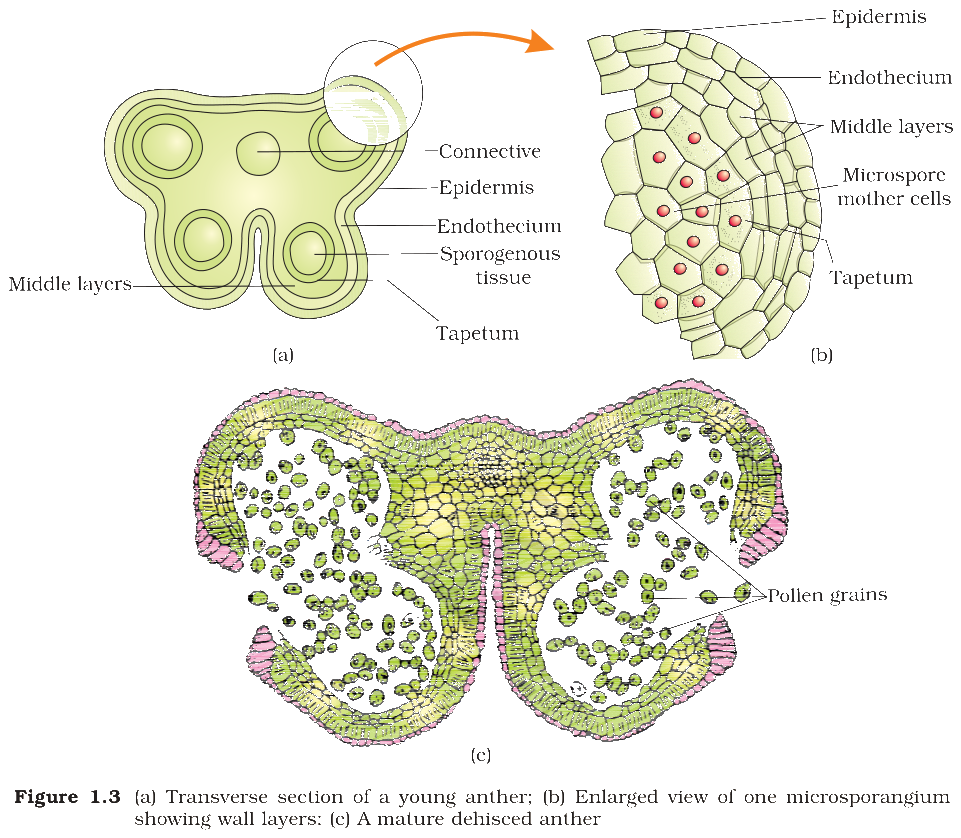
Textbook figure

Advertisement

Practise more on Sexual Reproduction in Flowering Plants

Chapter-wise mocks on the real NTA exam screen, with solutions and your rank. Your first mocks are free.

Start free mocks →

Advertisement

Next questions

  1. 15% of 20% of S = 126. What is the value of S?General Aptitude Test · Numerical Ability
  2. Which one of the following disease is not caused by bacteria?Biology · Human Health and Disease
  3. The density of population of an area is measured in which of the following terms?Geography · Fundamentals of Human Geography: World Population-Distribution, Density and growth
  4. Select the option that is related to the third number in the same way as the second number is related to the first number. 3 : 20 :: 7 : ?General Aptitude Test · General Ability
  5. mRNA silencing through RNA interference (RNAi) refers to the:Biology · Biotechnology and its Applications
  6. A Hyderabad painting shows Hazrat Nizamuddin Auliya, the thirteenth-century Sufi saint. Who is shown playing music for him as his disciple?Fine Arts · The Deccani Schools of Painting
  7. Where were the 5th edition of the Khelo India Youth Games held in 2023?General Aptitude Test · Current Affairs
  8. Select the set of letters that when sequentially placed in the blanks of the given letter series will complete the series. p_hk_ph_kp_hk_ph…General Aptitude Test · General Ability
  9. वर्तमान विशेषज्ञों का मानना है:Hindi · Comprehension - (Narrative / Factual)
  10. A class has five sections that have 25, 30, 40, 45 and 60 students, respectively. The pass percentage of these sections are 20%, 30%, 35%,…General Aptitude Test · Numerical Ability