
CUETMOCK
  • Pricing
  • Mentors
Log inStart freeStart free mocks→

First test, then trust

Try a free CUET mock test.

Join 5,00,000+ students who rehearsed exam day on the exact NTA screen before sitting CUET. On the web and on Android.

Start free mocks →Get the Android app
CUETMOCK

India's #1 CUET Mock Test Platform. Original NCERT-based questions on the exact NTA exam screen — trusted by 5,00,000+ students since CUET 2022.

Get it onGoogle PlayScan to download the CUETMOCK app

Mock tests

  • CUET mock test series
  • Commerce mocks
  • Humanities (Arts) mocks
  • Science mocks
  • Languages & GAT mocks
  • Free practice questions
  • Pricing

Resources

  • CUET exam guide
  • CUET syllabus
  • Universities accepting CUET
  • Expert blogs
  • News & notifications
  • Webinars & counselling
  • CUET score calculator
  • How we estimate your rank
  • FAQs

Company

  • About us
  • Our leadership & team
  • Our toppers
  • Mentors
  • For schools
  • Contact us
  • Terms
  • Privacy
  • Refund policy

Talk to us

+91 7696 6630 56info@cuetmock.comWhatsApp us

Our other platforms

  • JEE Mock — For IIT-JEE aspirants
  • NEET Mock — For NEET aspirants

Newsletter

Exam updates, study material and offers — no spam.

© 2026 NYC Ventures Pvt. Ltd.

701-702, Royal Business Park, Zirakpur, Punjab - 140603

  • Terms of use
  • Privacy policy
  • Refund policy
  • Contact us

iCUETMOCK is an independent preparation platform, not affiliated with the National Testing Agency (NTA). Always check exam details on the official NTA website.

  • Home
  • Mock tests
  • CUET guide
  • Pricing
  • Log in
Home/Practice questions/Chemistry
ChemistryOrganic: Aldehydes, Ketones and Carboxylic Acids

The figure shows the mechanism of the nucleophilic addition reaction…

The figure shows the mechanism of the nucleophilic addition reaction of an aldehyde or a ketone.
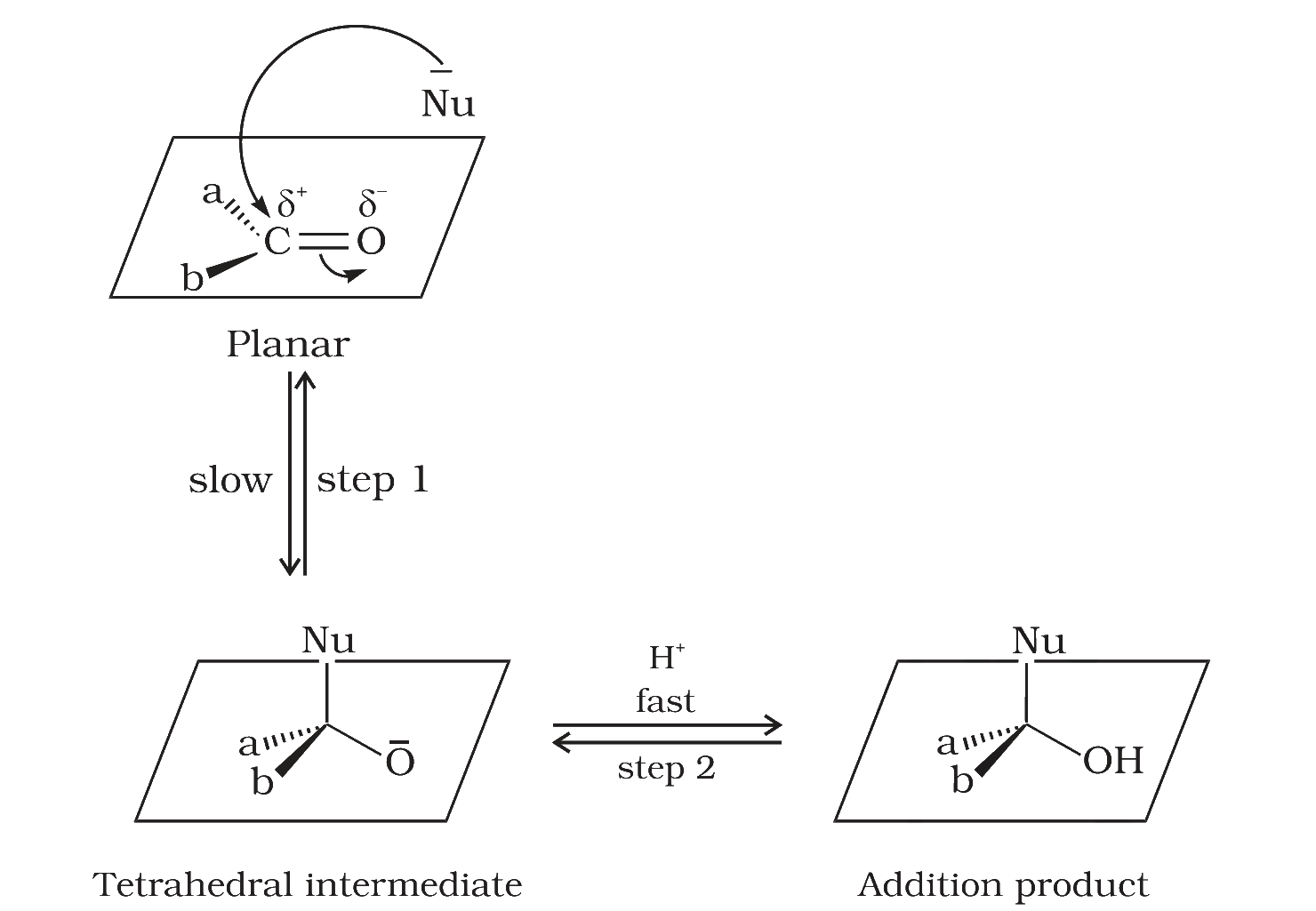
Fig. 8.2 Nucleophilic attack on carbonyl carbon

What is the hybridisation of the carbonyl carbon in the starting compound and in the tetrahedral intermediate, respectively?

Answer & explanation+

Correct answer: option 2

The correct answer is Option (2) → sp2 and sp3

The figure labels the starting carbonyl compound planar and the species formed in step 1 a tetrahedral intermediate. A planar carbon with three groups is sp2; a tetrahedral carbon with four groups is sp3.

  • Starting compound — sp2. The carbonyl carbon forms three σ bonds and one π bond with oxygen. It and the three atoms attached to it lie in one plane, with bond angles of about 120°.

  • Tetrahedral intermediate — sp3. In step 1 the nucleophile bonds to the carbonyl carbon, and the π bond breaks. The carbon now has four groups around it, so it becomes sp3 and tetrahedral.

Why the other options are incorrect

Option (1) sp2 and sp — Incorrect. An sp carbon is linear, with two groups; the carbon in the intermediate has four groups.

Option (3) sp3 and sp2 — Incorrect. This reverses the change. The planar starting compound is sp2, and the intermediate is sp3.

Option (4) sp and sp3 — Incorrect. The carbonyl carbon of the starting compound has three groups in one plane, so it is sp2, not sp.

NCERT (2026-27 edition):
8.4 Chemical Reactions – “A nucleophile attacks the electrophilic carbon atom of the polar carbonyl group from a direction approximately perpendicular to the plane of sp2 hybridised orbitals of carbonyl carbon (Fig. 8.2). The hybridisation of carbon changes from sp2 to sp3 in this process, and a tetrahedral alkoxide intermediate is produced.”

8.1.2 Structure of the Carbonyl Group – “The carbonyl carbon atom is sp2-hybridised and forms three sigma (σ) bonds. … Thus, the carbonyl carbon and the three atoms attached to it lie in the same plane …”

Fig. 8.2

Fig. 8.2: Nucleophilic attack on carbonyl carbon

Advertisement

Practise more on Organic: Aldehydes, Ketones and Carboxylic Acids

Chapter-wise mocks on the real NTA exam screen, with solutions and your rank. Your first mocks are free.

Start free mocks →

Advertisement

Next questions

  1. The HCF and LCM of two numbers are 15 and 900 respectively and the two numbers are in ratio 5 : 3. Find the small number?General Aptitude Test · Numerical Ability
  2. If 2 […] + […] = […] , write the value of (x - y).Maths. Section B1 · Matrices
  3. The play Mrichchhakatika is written by:History · Ancient India: Kinship, Caste and Class
  4. बनारसी लंगड़ा आम पूरे विश्व में जाना-पहचाना जाता है| वाक्य में प्रयुक्त विशेषण कौनसा है?Hindi · व्याकरण - विशेषण
  5. 'तत्सम-तद्भव' का कौन-सा युग्म असंगत है?Hindi · व्याकरण - सशब्द विचार
  6. Which of the following statements is correct?English · Comprehension - (Narrative / Factual)
  7. Which hormone controls the reabsorption of water in the kidneys?Chemistry · Organic: Biomolecules
  8. If A = {1, 2, 3} and B = {3, 8}, then (A ∪ B) × (A ∩ B) isMaths. Section B1 · Relations and Functions
  9. Express the vector joining the two points A(0, 1, 2) and B(1, 4, 4) as the sum of the components along x, y and z axes using unit vectors i…Maths. Section B1 · Vectors
  10. Let vec a and vec b be two non-zero vectors. Statement-1: (i) |vec a +vec b|^2 = |vec a|^2 + |vec b|^2 + 2 (vec a.vec b) (ii) |vec a−vec b|…Maths. Section B1 · Vectors