Identify the incorrect statement in the context of circular flow of income :
(A) Household provides factor services to firms
(B) Household receives goods and services from firms
(C) Firms receive factor payments from households
(D) Factor services includes : land, labour, Capital and Entrepreneur
(E) In a simple economy, there are three sectors : Households, Firms & Government
Choose the correct answer from the options given below :
Answer & explanation
Correct answer: option 3
The correct answer is Option (3) → (C) & (E) only
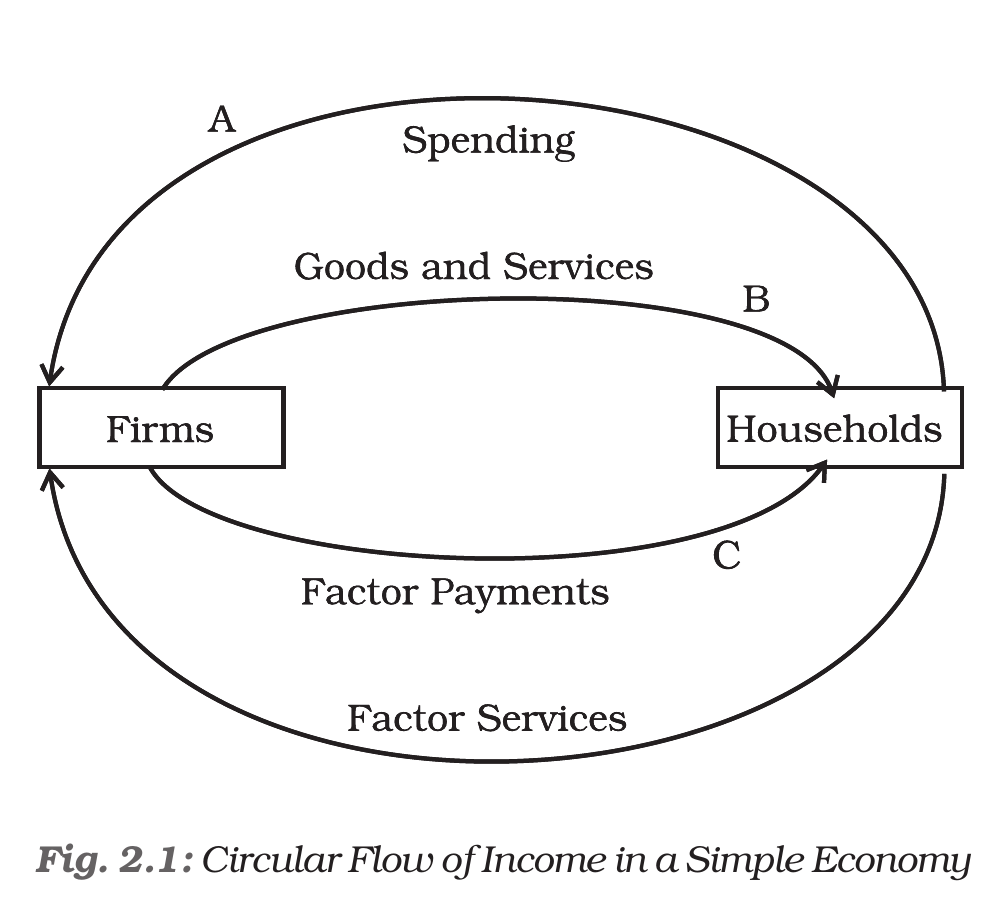
In the circular flow of income of a simple economy there are two sectors, households and firms. Households supply factor services to firms and get paid for them. They spend this income on the goods and services the firms produce, and the money flows back to the firms.
(A) Household provides factor services to firms — True. Households own land, labour, capital and entrepreneurship, and supply their services to firms for production.
(B) Household receives goods and services from firms — True. Firms produce goods and services, and households buy them for consumption.
(C) Firms receive factor payments from households — False. It is the firms that make factor payments (rent, wages, interest and profit) to households. Firms receive sales revenue from households.
(D) Factor services includes : land, labour, Capital and Entrepreneur — True. These are the four factors of production. Their rewards are rent, wages, interest and profit.
(E) In a simple economy, there are three sectors : Households, Firms & Government — False. A simple economy has only two sectors, households and firms. The government is left out.
NCERT (2026-27): “2.2 Circular Flow of Income and Methods of Calculating National Income The description of the economy in the previous section enables us to have a rough idea of how a simple economy – without a government, external trade or any savings – may function. The households receive their payments from the firms for productive activities they perform for the latter. As we have mentioned before, there may fundamentally be four kinds of contributions that can be made during the production of goods and services (a) contribution made by human labour, remuneration for which is called wage (b) contribution made by capital, remuneration for which is called interest (c) contribution made by entrepreneurship, remuneration of which is profit (d) contribution made by fixed natural resources (called ‘land’), remuneration for which is called rent.… …Hence year after year we can imagine the aggregate income of the economy going through the two sectors, firms and households, in a circular way. This is represented in Fig. 2.1.… …The second arrow going from the firms to the households is the counterpart of the arrow above. It stands for the goods and services which are flowing from the firms to the households.… The lower most arrow going from the households to the firms symbolises the services that the households are rendering to the firms. Using these services the firms are manufacturing the output. The arrow above this, going from the firms to the households, represents the payments made by the firms to the households for the services provided by the latter.…”
|