
Read the passage and answer the question.
The base of a pyramid is broad and it narrows towards the apex. One gets a similar shape whether one expresses the food or energy relationship between organisms at different trophic levels. This relationship is expressed in terms of number, biomass or energy. The base of each pyramid represents the producers or the first trophic level, while the apex represents the tertiary or top level consumer. Any calculation of energy content, biomass or numbers has to include all organisms at that trophic level. No generalisation we make will be true if we take only a few individuals at any trophic level into account. Also, a given organism may occupy more than one trophic level simultaneously. One must remember that the trophic level represents a functional level, not a species as such. In most ecosystems, all the pyramids, of number, of energy and of biomass, are upright. There are, however, exceptions to this generalisation.
Match List-I (pyramid shown in NCERT Figure 12.4) with List-II (what the figure shows):
| List-I | List-II |
|---|---|
| A. Pyramid of numbers in a grassland ecosystem | I. Shows a sharp decrease in biomass at higher trophic levels |
| B. Upright pyramid of biomass | II. Only three top-carnivores are supported on the production of nearly 6 million plants |
| C. Inverted pyramid of biomass | III. Primary producers convert only 1% of the energy in the sunlight available to them into NPP |
| D. Ideal pyramid of energy | IV. A small standing crop of phytoplankton supports a large standing crop of zooplankton |
Choose the correct answer from the options given below:
Answer & explanation
Correct answer: option 3
The correct answer is Option (3) → A-II, B-I, C-IV, D-III
NCERT shows three kinds of ecological pyramids in Figure 12.4: of number, of biomass and of energy. Most are upright, with the producers at the broad base. The pyramid of biomass in the sea is the usual exception.
(A) Pyramid of numbers in a grassland ecosystem — this matches (II) Only three top-carnivores are supported on the production of nearly 6 million plants. The counts fall from millions of plants at the base to just three top carnivores at the apex.
(B) Upright pyramid of biomass — this matches (I) Shows a sharp decrease in biomass at higher trophic levels. Dry weight drops steeply from the producers to the tertiary consumers.
(C) Inverted pyramid of biomass — this matches (IV) A small standing crop of phytoplankton supports a large standing crop of zooplankton. Here the producer bar is smaller than the consumer bar, so the pyramid stands upside down.
(D) Ideal pyramid of energy — this matches (III) Primary producers convert only 1% of the energy in the sunlight available to them into NPP. Energy is shown from the sunlight upwards, falling at each step.
Note: Not one of the four List-II lines comes from a paragraph; each is borrowed from the caption under its own pyramid in Figure 12.4. Four small captions gave a full match question, so a pyramid is worth reading from its bars down to the last line beneath it.
NCERT Extract:
Ecological Pyramids – “… This, relationship is expressed in terms of number, biomass or energy. The base of each pyramid represents the producers or the first trophic level while the apex represents tertiary or top level consumer. The three types of ecological pyramids that are usually studied are (a) pyramid of number; (b) pyramid of biomass and (c) pyramid of energy. For detail (see Figure 12.4 a, b, c and d).”
Ecological Pyramids – “… The pyramid of biomass in sea is generally inverted because the biomass of fishes far exceeds that of phytoplankton.”
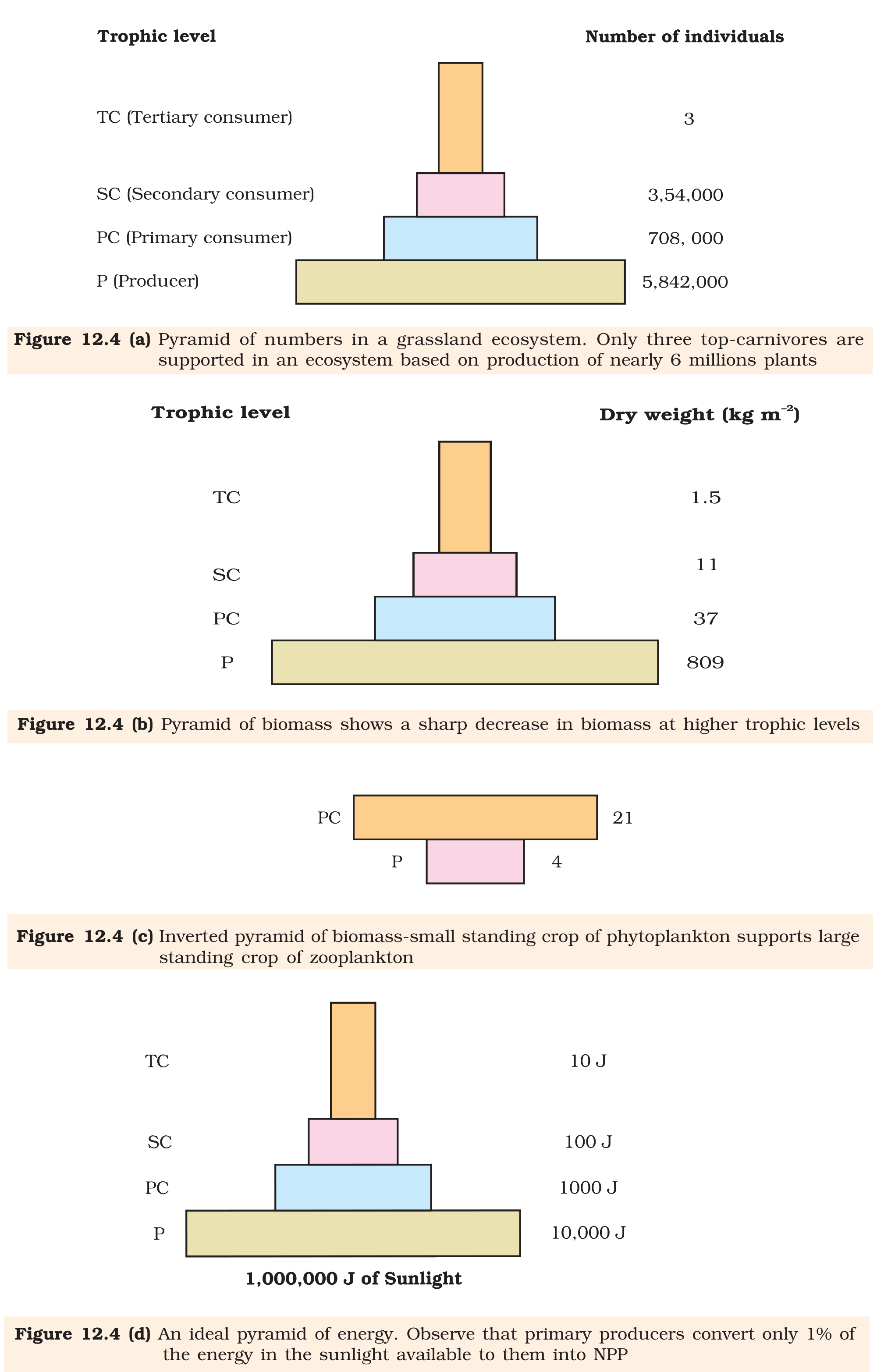
Figure 12.4 (a) Pyramid of numbers in a grassland ecosystem. Only three top-carnivores are supported in an ecosystem based on production of nearly 6 millions plants
Figure 12.4 (b) Pyramid of biomass shows a sharp decrease in biomass at higher trophic levels
Figure 12.4 (c) Inverted pyramid of biomass-small standing crop of phytoplankton supports large standing crop of zooplankton
Figure 12.4 (d) An ideal pyramid of energy. Observe that primary producers convert only 1% of the energy in the sunlight available to them into NPP