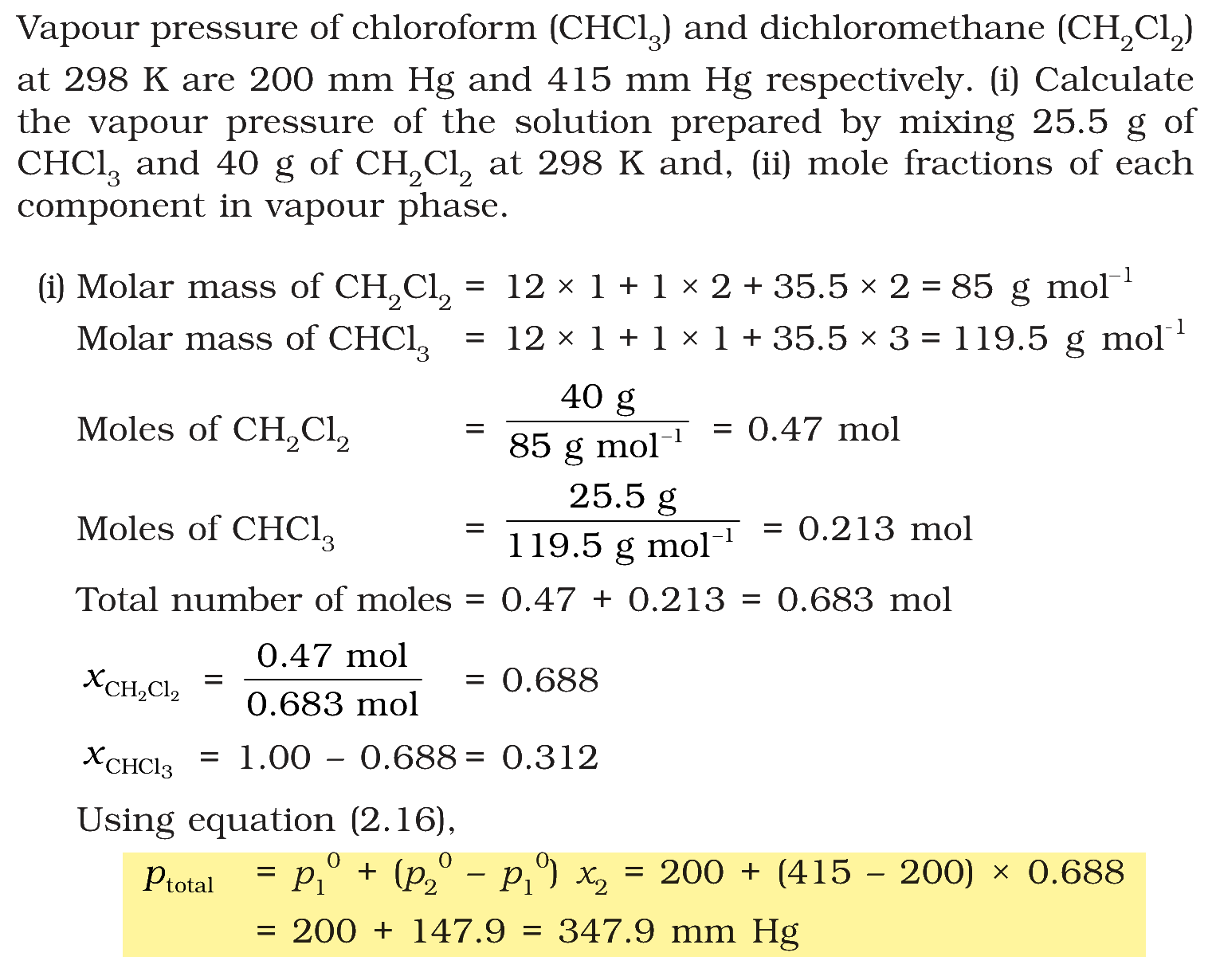
Vapour pressures of chloroform (\( CHCl_3 \)) and dichloromethane (\( CH_2Cl_2 \)) at 298 K are 200 mmHg and 415 mmHg, respectively. Calculate the vapor pressure of the solution prepared by mixing 0.2 mol of \( CHCl_3 \) and 0.5 mol of \( CH_2Cl_2 \) at 298 K
Answer & explanation
Correct answer: option 2
The correct answer is Option (2) → 353.57 mmHg
Chloroform and dichloromethane are both volatile, and their mixture behaves almost ideally. By Raoult’s law, the partial vapour pressure of each component is its vapour pressure in the pure state multiplied by its mole fraction, and the total vapour pressure is the sum of the partial pressures:
\( \displaystyle p_{\text{total}} = p_1^{0}\,x_1 + p_2^{0}\,x_2 \)
The mole fractions from 0.2 mol of \( \ce{CHCl3} \) and 0.5 mol of \( \ce{CH2Cl2} \) (0.7 mol in all) are
\( \displaystyle x_{\ce{CHCl3}} = \frac{0.2}{0.7} = 0.2857 \qquad x_{\ce{CH2Cl2}} = \frac{0.5}{0.7} = 0.7143 \)
\( \displaystyle p_{\ce{CHCl3}} = 200 \times 0.2857 = 57.14\ \mathrm{mm\,Hg} \)
\( \displaystyle p_{\ce{CH2Cl2}} = 415 \times 0.7143 = 296.43\ \mathrm{mm\,Hg} \)
\( \displaystyle p_{\text{total}} = 57.14 + 296.43 = 353.57\ \mathrm{mm\,Hg} \)
So the vapour pressure of the solution is 353.57 mm Hg.
Shortcut: The total vapour pressure must lie between the two pure-liquid values, 200 and 415 mm Hg, which rules out 878.57. It must also lie above their midpoint, 307.5, because the more volatile \( \ce{CH2Cl2} \) is the larger part of the mixture. Only 353.57 and 360.5 remain, and the calculation above picks 353.57.
Note: NTA picked this question from an NCERT (2026-27) example and changed the figures. Do not ignore NCERT while practising numericals.
NCERT (2026-27 edition):
Vapour Pressure of Liquid-Liquid Solutions – …