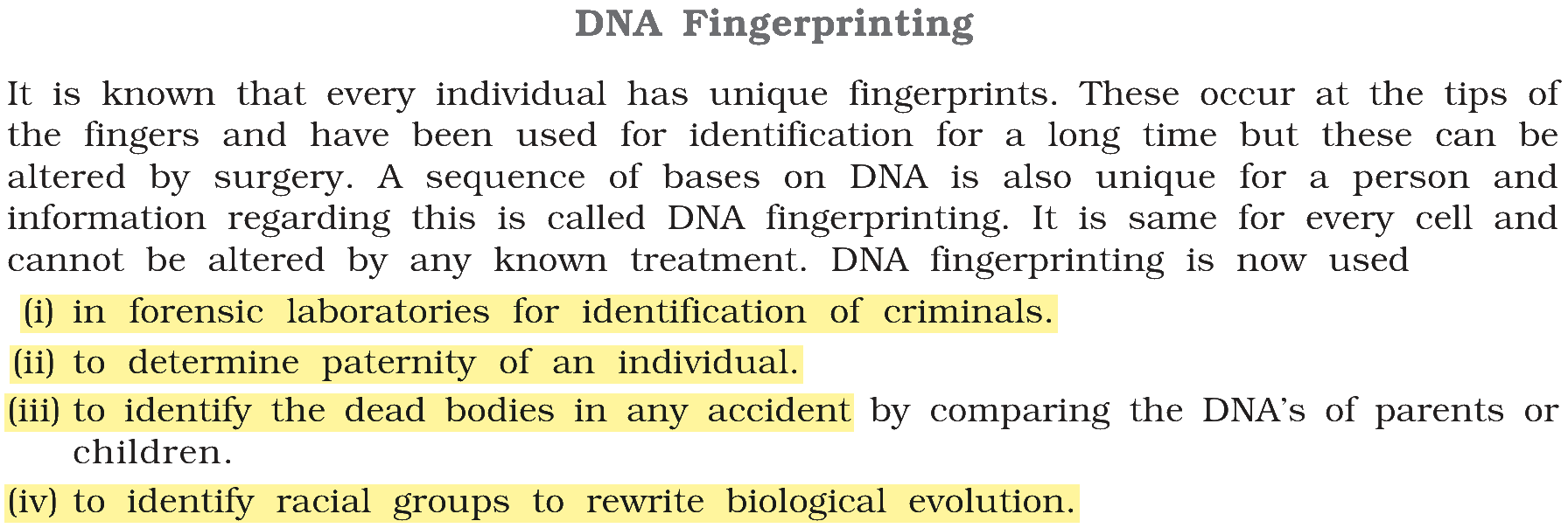
DNA fingerprinting is used for:
(A) Forensic Laboratories for identification of criminals
(B) To identify paternity of an individual
(C) To identify the dead bodies by comparing the DNA of parents or children
(D) To identify racial groups, to rewrite biological evolution.
Choose the correct answer from the options given below:
Answer & explanation
Correct answer: option 2
The correct answer is Option (2) → (A), (B), (C) and (D)
The sequence of bases in DNA is unique for each person and is the same in every cell, so a DNA sample can be matched with that of a person or of his or her relatives.
(A) Forensic Laboratories for identification of criminals — Correct. DNA from blood, hair or skin left at a crime scene is matched with that of a suspect.
(B) To identify paternity of an individual — Correct. A child inherits half of its DNA from each parent, so the bands of the child’s DNA fingerprint match those of the true parents.
(C) To identify the dead bodies by comparing the DNA of parents or children — Correct. When a body cannot be recognised, as after an accident, its DNA is compared with that of close relatives.
(D) To identify racial groups, to rewrite biological evolution. — Correct. Comparing DNA sequences of populations shows how closely groups are related, which is used to trace and rewrite the course of biological evolution.
NCERT (2026-27 edition):
DNA Fingerprinting